
NCLEX-RN guideStudy & Preparation
NCLEX Prioritization & Delegation: Who Should the Nurse See First?
Use acuity, changing cues, scope, competency, and follow-up to reason through NCLEX prioritization and delegation questions.
Short answer
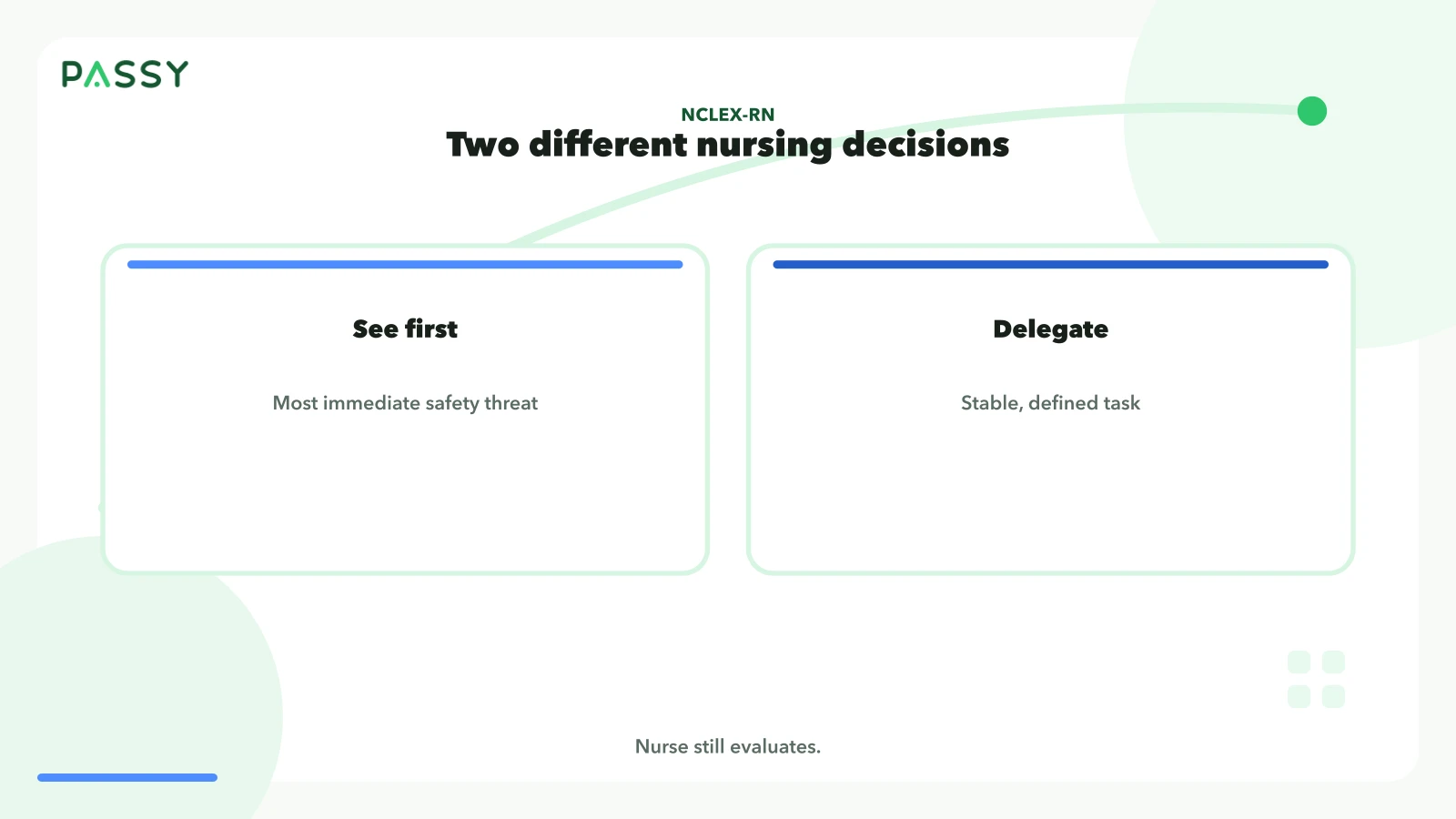
For NCLEX prioritization, identify the client with the most immediate safety threat or meaningful change, then choose the nursing action that addresses that risk. For delegation, match a stable, defined task to a team member whose role and demonstrated competency allow it, while the nurse keeps responsibility for appropriate direction, supervision, and evaluation.
Where prioritization and delegation appear in the test plan
Both skills sit within Management of Care, which represents 15–21% of the current NCLEX-RN test plan. That range covers the whole subcategory—not a promised number of prioritization or delegation items. Keep the emphasis on the decision rather than on predicted item counts.
The official activity statements ask entry-level nurses to:
- prioritize care for multiple clients based on acuity.
- apply pathophysiology when choosing interventions.
- identify client needs that can be delegated.
- consider staff competency and permitted duties.
- communicate directions and expected results.
- supervise and evaluate delegated work.
The clinical-judgment model also asks candidates to prioritize hypotheses using urgency, likelihood, risk, difficulty, and time constraints.
Who should the nurse see first?
Start by finding the cue that changes the risk. A useful sequence is:
- Identify an immediate threat. Look for compromised airway, breathing, circulation, acute neurologic change, severe bleeding, or another time-sensitive safety problem.
- Separate a new change from an expected finding. A sudden or unexplained change usually needs faster assessment than a stable, anticipated need.
- Compare acuity and time sensitivity. Ask what harm could occur if care waits.
- Check whether more assessment is safe. Assessment is not automatically first when the item already shows an emergency that requires immediate action.
- Choose the action supported by the available cues. Do not add facts that the scenario did not provide.
No mnemonic overrides the actual client information. Airway-first language can be useful, but a patent airway does not make every breathing-related option the priority. Use the severity, change, and likely consequence in the specific scenario.
Work prioritization questions with explained answers in the Passy NCLEX-RN prep app by naming the cue that creates urgency before looking at the answer choices.
An original prioritization example
Imagine four clients:
- a client with expected incisional pain who is requesting a prescribed analgesic.
- a client awaiting routine discharge teaching.
- a client whose oxygen saturation has just fallen and who now has new restlessness.
- a stable client who needs help walking to the bathroom.
The new oxygenation change and restlessness create the most immediate concern. The point is not to memorize “oxygen always wins.” It is to recognize that a new, potentially worsening threat carries more urgency than stable or expected needs.
Then ask what the nurse can safely do first: assess the client, verify the reading and airway/breathing status, apply an indicated immediate nursing intervention, or escalate according to the scenario. The best action depends on what the item has already established. To test that habit, compare your first-action choice with the rationale in the Passy NCLEX-RN prep app.
How to reason through delegation questions
Delegation starts with the client and task, not the job title alone.
Use the official rights of delegation as a check:
- Right task: Is the activity defined and appropriate to delegate?
- Right circumstances: Is the client sufficiently stable, and are the setting and resources appropriate?
- Right person: Does the team member's role, permitted duties, and demonstrated competency fit?
- Right direction and communication: Are the task, limits, observations to report, and expected result clear?
- Right supervision and evaluation: Is follow-up built into the plan?
Scope and delegation rules vary by jurisdiction and organization. An NCLEX answer should fit the role information in the item and safe entry-level practice; a study shortcut should never replace current law or facility policy.
An original delegation example
A stable client has an established mobility plan and needs routine assistance walking after breakfast. A trained assistive team member may be an appropriate choice when the nurse communicates the distance, precautions, when to stop, and what findings to report.
That differs from asking the team member to:
- perform the initial assessment of a newly unstable client.
- decide why the client became dizzy.
- independently revise the plan of care.
- evaluate whether a new intervention worked.
The nurse should not delegate the clinical judgment that defines, changes, or evaluates the plan. Practice delegation questions that separate the task from the judgment in the Passy NCLEX-RN prep app.
Common priority-question traps
Watch for these patterns:
- choosing the most dramatic diagnosis without checking the current cues.
- treating every “assess” option as automatically correct.
- using “acute before chronic” without noticing that the chronic condition is now unstable.
- choosing the first step of a memorized framework when the scenario already completed it.
- delegating based only on convenience.
- forgetting supervision and follow-up.
- adding an unstated provider order, policy, or assessment result.
Instead, explain why the selected client or task is safer now.
Build the skill with short, deliberate practice
Use the free 20-question NCLEX practice experience to practice identifying the most important cue and reviewing the rationale before moving on.
Connect priority decisions with how numeric lab values are presented on the NCLEX and how to approach medication questions. These topics often become clearer when you ask the same question: what is the safest next action supported by the current information? When the framework feels clear, keep practicing the safest next action with mixed questions in the Passy NCLEX-RN prep app without turning one rule into an automatic answer.
Trust the source
Official sources
Exam policies can change. Use these primary sources for the most current details.