
NCLEX-RN guideStudy & Preparation
NCLEX Pharmacology: What to Study and How to Answer Medication Questions
Study NCLEX pharmacology through medication safety, assessment, monitoring, teaching, adverse effects, and clinical judgment—not an invented drug list.
Short answer
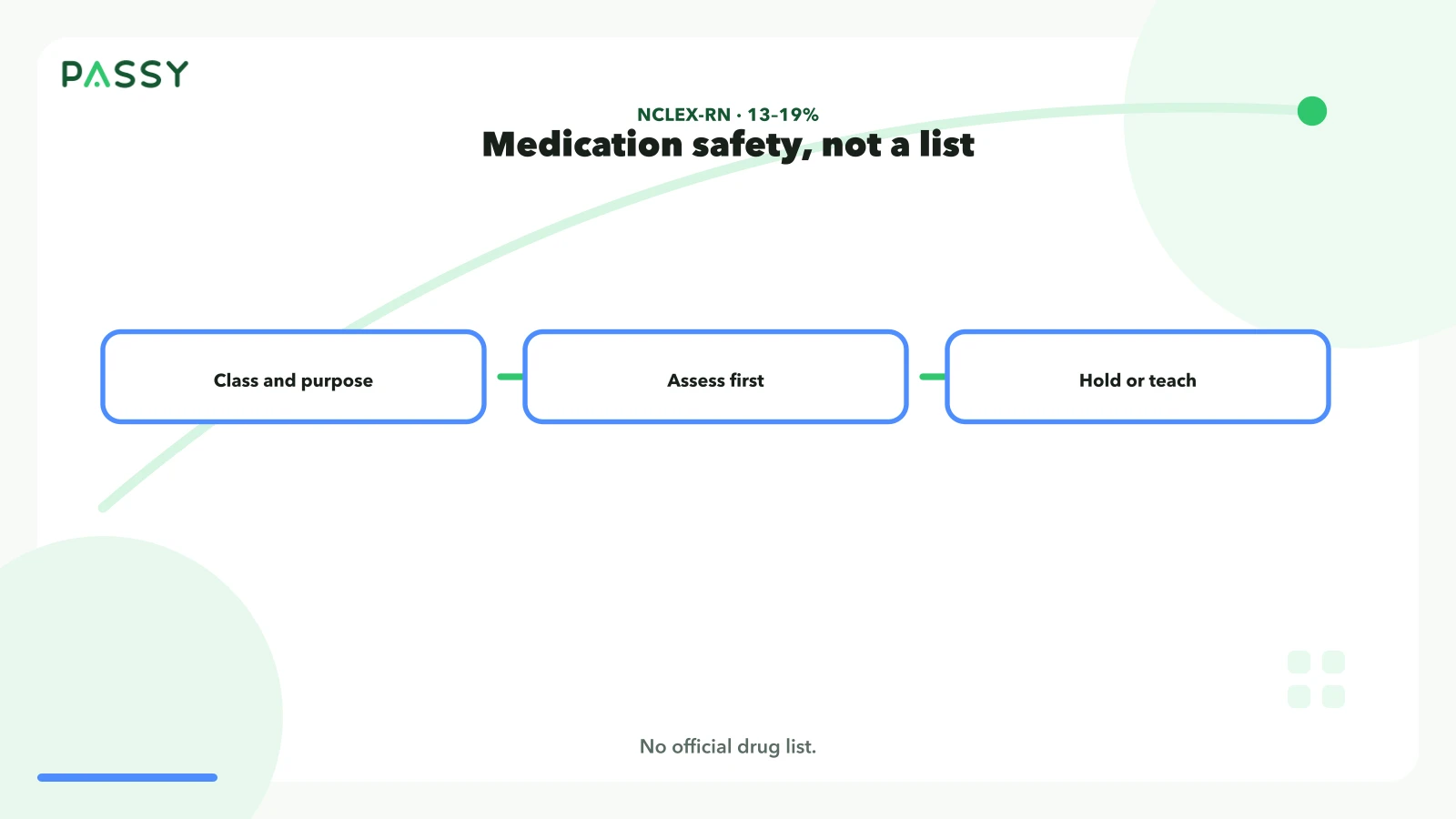
Study NCLEX pharmacology by connecting medication classes and purposes to safe administration: what to assess first, relevant labs and contraindications, expected effects, serious adverse effects, client teaching, monitoring, and response. NCSBN does not publish a fixed list of medications that candidates must know.
How much pharmacology is on the NCLEX-RN?
Pharmacological and Parenteral Therapies represents 13–19% of the 2026 NCLEX-RN test plan. The official definition is broader than memorizing medication names: it covers care related to medication administration and parenteral therapies. Because that scope is decision-based, organize medication practice by purpose, risk, and monitoring instead of relying on isolated name recall.
The range applies to the whole subcategory. It can include medication orders, calculations, reconciliation, intravenous therapy, blood products, venous-access devices, pain management, high-risk medications, teaching, monitoring, and evaluation.
It does not mean 13–19% of your exam will be simple drug-name recall.
Is there a must-know NCLEX medication list?
No official fixed list exists. The current NCLEX FAQ states that NCSBN does not specify a list of medications that are on the exam.
NCLEX says most medication references use generic names, while some items may refer to general medication classifications. That makes class patterns useful, but it does not turn any third-party “top drugs” list into an official blueprint.
Avoid claims that a particular medication “always appears” or is tested most often unless NCSBN publishes that information. It does not publish item frequency for individual drugs.
What should you study for medication questions?
Build a repeatable safety map for each useful class or medication:
Purpose
- Why is the client receiving it?
- What therapeutic effect should occur?
- How does that purpose connect to the client's condition?
Before administration
- What assessment data matter?
- Which allergies, interactions, contraindications, or precautions matter?
- Which laboratory results or vital signs are relevant?
- Is the order complete, accurate, and appropriate for the client?
Safe administration
- What route, timing, calculation, or handling issue matters?
- Is the medication high risk or controlled?
- What should be verified according to the order and safe practice?
Monitoring and evaluation
- Which expected effect shows that the medication is working?
- Which adverse finding needs prompt follow-up?
- What trend matters more than one isolated value?
- What should the nurse document or communicate?
Client teaching
- What should the client know about use, precautions, monitoring, and when to seek help?
- Can the client explain the important instruction back clearly?
To build that habit, answer medication-safety questions with explained rationales in the Passy NCLEX-RN prep app and say the assessment, action, and expected response behind each answer.
Organize pharmacology by patterns
A long alphabetical drug list is difficult to retrieve in a clinical scenario. Group review around patterns such as:
- therapeutic purpose and body system.
- class effects and serious risks.
- assessment before administration.
- laboratory or vital-sign monitoring.
- route-specific safety.
- interactions and contraindications.
- client teaching.
- signs that require holding the process and clarifying the order.
Some common study patterns look like this. They are examples of how to organize review, not a list of medications NCSBN says will appear.
| Medication group | Check before giving | Watch for afterward |
|---|---|---|
| Anticoagulants such as heparin and warfarin | Bleeding signs, the relevant clotting test (aPTT or INR), and platelets with heparin | Bleeding gums, bruising, blood in urine or stool |
| Digoxin | Apical pulse for a full minute and the potassium level | Slow or irregular pulse, nausea, vision changes |
| Insulin | Blood glucose and meal timing | Shakiness, sweating, confusion, and other signs of hypoglycemia |
| Opioids | Respiratory rate, sedation level, and pain | Slowed breathing, increasing sedation, constipation |
| Loop diuretics such as furosemide | Blood pressure, potassium, and intake and output | Low potassium, dehydration, dizziness on standing |
| ACE inhibitors such as lisinopril | Blood pressure, potassium, and kidney function | Dry cough, facial or tongue swelling, high potassium |
“Hold the medication” is not a universal answer. Use the stated order parameters, assessment findings, and safety concern in the item. Some findings call for more assessment, some for clarification, and some for immediate intervention.
Review how the NCLEX presents numeric laboratory values so you can spend less effort memorizing every range and more effort interpreting the information provided.
Use clinical judgment, not medication trivia
Here is an original worked example in which the order prints its own limits. It shows a way of reasoning, not a dosing rule.
The order reads: metoprolol 25 mg by mouth twice daily; hold if systolic blood pressure is below 100 mm Hg or apical pulse is below 60/min, and notify the prescriber. Before the morning dose, the client's blood pressure is 88/52 mm Hg, the apical pulse is 64/min, and the client reports new dizziness on standing.
- Find the finding the order names. A systolic pressure of 88 is below the printed limit of 100. The pulse is above 60, so the blood pressure alone meets the hold condition.
- Follow the order as written. It says to hold and notify, so giving the dose because it is due, or giving half of it, does not fit.
- Address the risk the finding creates. Low pressure with new dizziness on standing is a fall risk, so keep the client sitting or lying down and assist with any position change.
- Communicate and document. Report the reading, the symptom, and the held dose to the prescriber, and record your assessment.
Change one printed fact and the decision can change. If the order printed no parameter, an option that invents a cutoff would be using a fact the stem never gave; look instead for the option that assesses further or clarifies with the prescriber. The medication name, by itself, is not the decision.
Do not ignore parenteral therapies
The official category also includes:
- intravenous infusions and pump monitoring.
- central venous access.
- blood and blood-product administration.
- parenteral nutrition.
- medication calculations.
- safe handling and disposal.
- evaluation of the client's response.
Keep these topics connected to infection prevention, compatibility, monitoring, and rapid recognition of an adverse response.
A practical pharmacology study session
For one focused session:
- Review one medication class through purpose, assessment, risk, teaching, and evaluation.
- Answer a short set of original questions.
- Read every rationale, including correct answers.
- Write down the decision you missed—not just the drug fact.
- Revisit that decision after a delay.
Use the free NCLEX practice set for a short reasoning check, then review prioritization and delegation to strengthen the “what comes first?” thinking that medication questions often require. When another focused session would help, work through more pharmacology questions with explanations in the Passy NCLEX-RN prep app rather than relying on an unofficial must-know list.
Trust the source
Official sources
Exam policies can change. Use these primary sources for the most current details.