
Scene Size-Up and Safety · 15–19%
- Plan before arrival
- Hazards, PPE & scene protection
- Triage & additional resources
EMS & Emergency Care · Emergency care
The NREMT EMT exam is the National Registry's cognitive exam for EMT certification, the computer-based test many candidates call the written exam: 70–120 adaptive items in up to two hours, across five current EMT domains. It is separate from the State EMS Office approved BLS skills competency that certification also requires, and National Registry certification is not a state license to practice. This page covers the EMT level. Passy's NREMT Paramedic guides cover the Paramedic exam; EMR and AEMT are not covered.
Choose by intent
Go straight to the resource that matches the question in front of you.
Exam at a glance
The system selects items in response to its evolving ability estimate.
The range includes 10 unidentified unscored pilot items.
Prepare for the full testing window rather than a target stop.
Unsuccessful candidates see a scaled score with 950 as the passing point. It is not a percentage, and passing candidates get no score details.
The National Registry charges the EMT application fee for each examination attempt.
Wait 15 days before retesting and use the eligible date in your National Registry account. Candidates have six attempts.
Test at a Pearson VUE center or from home or an office with Pearson's online proctoring.
The updated examination launched April 7, 2025, with pediatric care integrated throughout.
What you’ll practice
Scan the official NREMT content areas and keep each study session connected to the wider exam.
Content-area names follow the official National Registry Emergency Medical Technician Examination Specifications.
NREMT EMT prep app
The free set on this site has 20 questions. The NREMT EMT prep app has 1,250 practice questions, each with an explanation, sorted into the five content areas of the NREMT EMT exam, plus 550 flashcards and a timed mock exam.
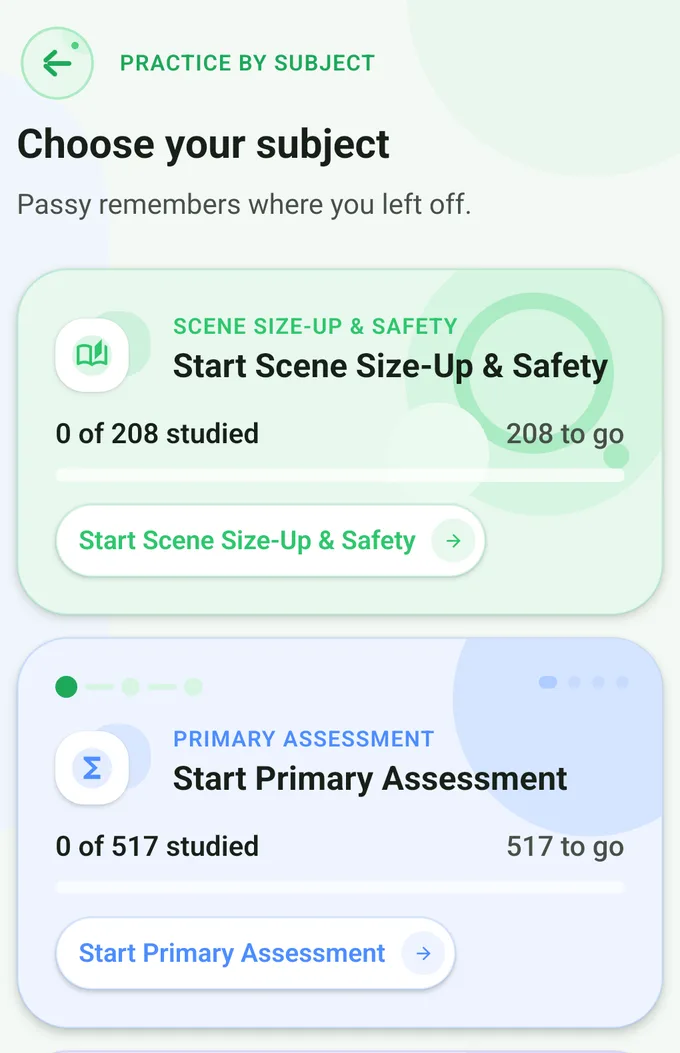
Practice by subject · Quick Practice
Pick any of the five NREMT EMT content areas and work through its questions. The app remembers where you stopped and shows how many questions are left in each area.
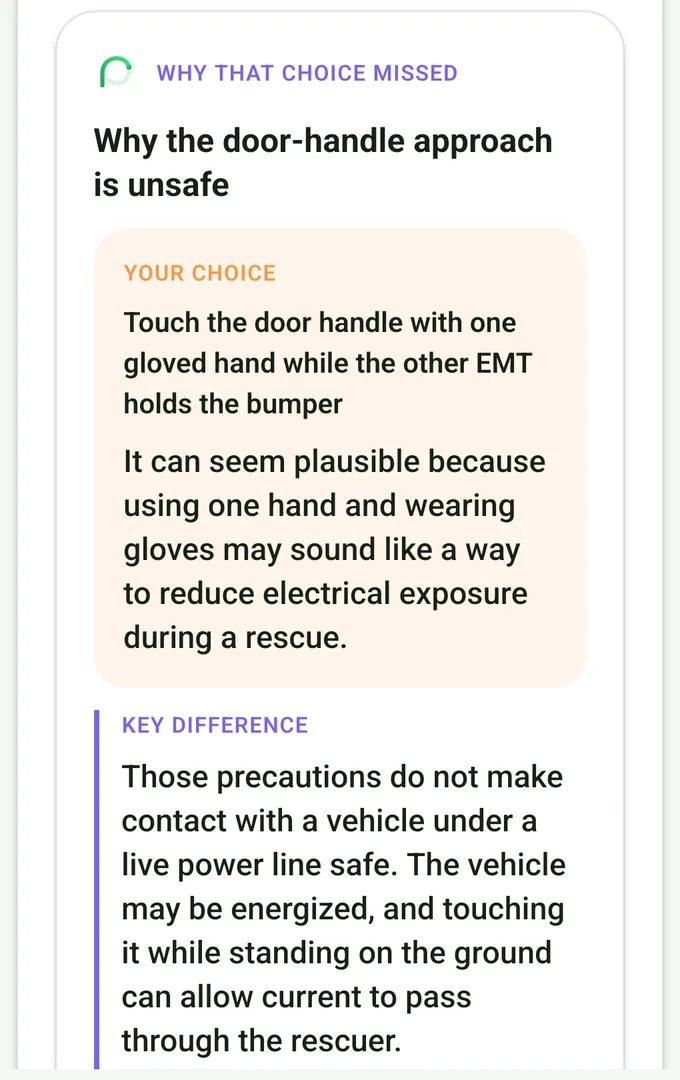
Answer explanations · AI Rescue
Each question shows the correct answer and an explanation as soon as you answer. When you need more, AI Rescue writes an AI-generated explanation of that question: Make it simple, Why was I wrong?, Challenge me or Give me a memory trick. AI Rescue needs an internet connection.
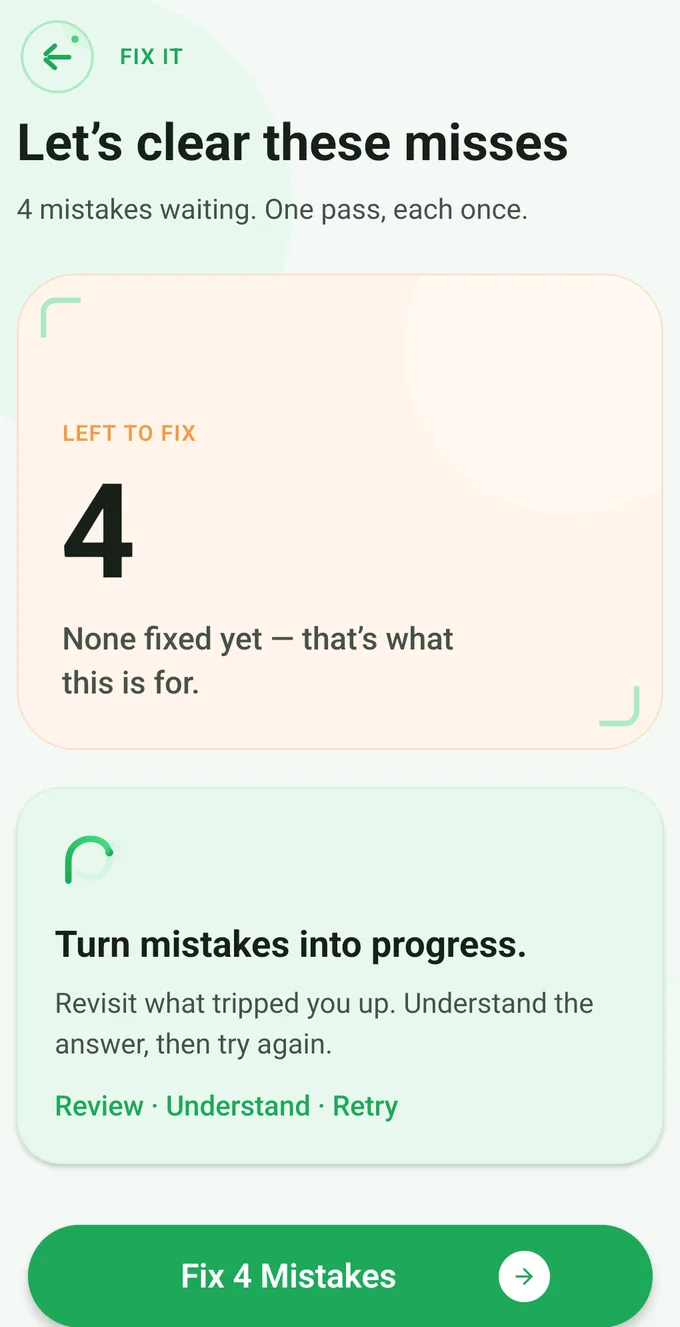
Fix It · Accuracy by subject
Fix It keeps every question you miss, so you can read the explanation and try it again. Accuracy by subject shows your weakest content area, so you know what to practice next.
Mock Exam · Flashcards
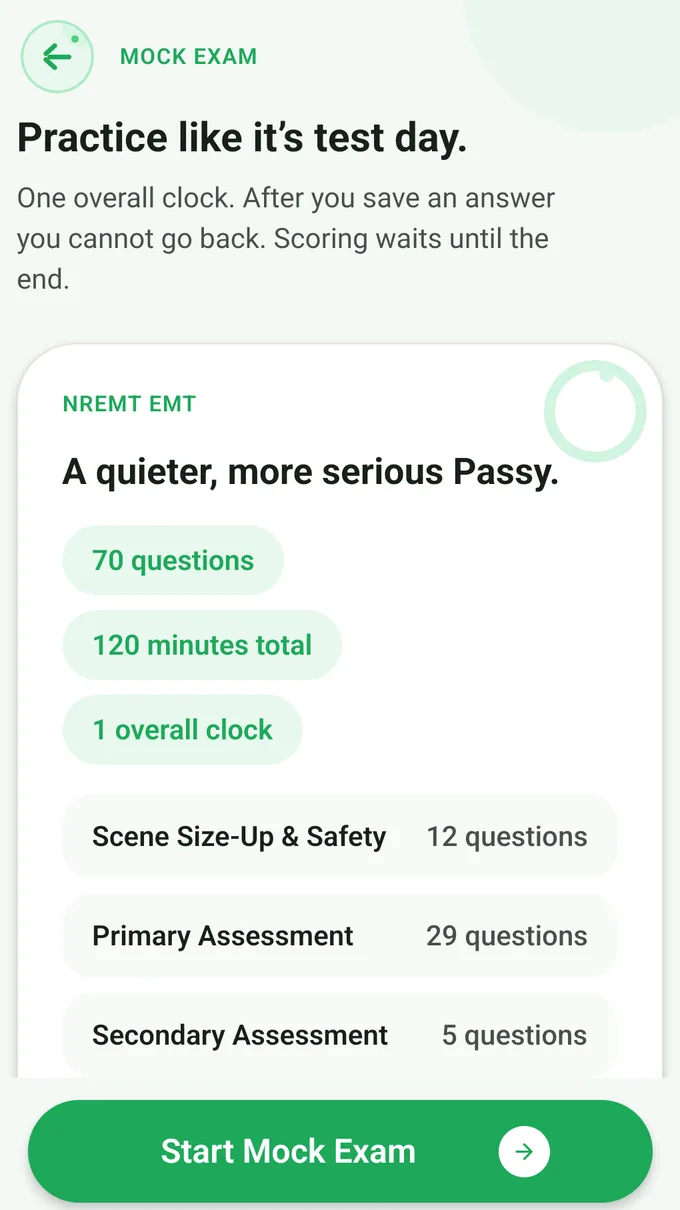
The mock exam has 70 questions from all five content areas and one 120-minute clock. You cannot go back after you save an answer, and you see your score at the end. For short reviews, 550 flashcards are sorted by content area, with a Quick 30 mix.
| Content area | Questions | Flashcards |
|---|---|---|
| Scene Size-Up and Safety15–19% of the exam | 208 | 92 |
| Primary Assessment39–43% of the exam | 517 | 226 |
| Secondary Assessment5–9% of the exam | 92 | 40 |
| Patient Treatment and Transport20–24% of the exam | 278 | 122 |
| Operations10–14% of the exam | 155 | 70 |
| Total | 1,250 | 550 |
Each area’s share of the app’s questions falls within its official exam weight.
Yes. The download is free, and the current app version gives new users full access when they finish setup, with no payment, trial or auto-renewal.
This site gives you 20 original questions, a study plan generator and guides, with no account. The app has all 1,250 questions and 550 flashcards, practice by content area, Fix It, AI Rescue and a timed mock exam.
No. The NREMT EMT cognitive exam is adaptive and can end anywhere from 70 to 120 items. The app’s mock exam is a fixed 70-question sitting with one 120-minute clock, and its score is practice feedback, not an NREMT result.
No. It is built for the cognitive exam. Its questions are four-option multiple choice; the official exam can also include technology-enhanced items.
No. Passy is an independent study app and is not affiliated with or endorsed by the National Registry of Emergency Medical Technicians.
Free NREMT resources
Keep practicing, build a study plan, or browse the NREMT guides.
Answer 20 original questions and learn from every rationale.
Start practice →Practical planning aidTurn the time you have into a clear study rhythm.
Build my outline →Source-backed answersGo straight to the question already on your mind.
Browse guides →Useful answers first
Study the five current NREMT EMT domains, understand their official ranges, and translate the post-April-2025 blueprint into practical priorities.
Read the guideUse a current-domain study loop that turns EMT source review into patient-care decisions, rationale diagnosis, and mixed reassessment.
Read the guideGet the current 70–120 total-item answer, understand where the 10 unscored pilots fit, and use the two-hour limit for sensible preparation.
Read the guideNational Registry EMT certification requires the cognitive exam and a State EMS Office approved BLS skills competency. The Registry does not set one required order. Each passed portion is valid 24 months.
Read the guide