
NREMT EMT guideExam Format
How Many Questions Are on the NREMT EMT Exam?
Get the current 70–120 total-item answer, understand where the 10 unscored pilots fit, and use the two-hour limit for sensible preparation.
Short answer
The current NREMT EMT certification exam contains 70–120 total items and allows two hours. Ten unidentified unscored pilot items are included within that range; they are not added on top. Scored items use dichotomous scoring—correct or incorrect, with no partial credit—while the 10 pilots do not affect the score. Because the exam is computerized adaptive, the final item count cannot predict a pass or fail result.
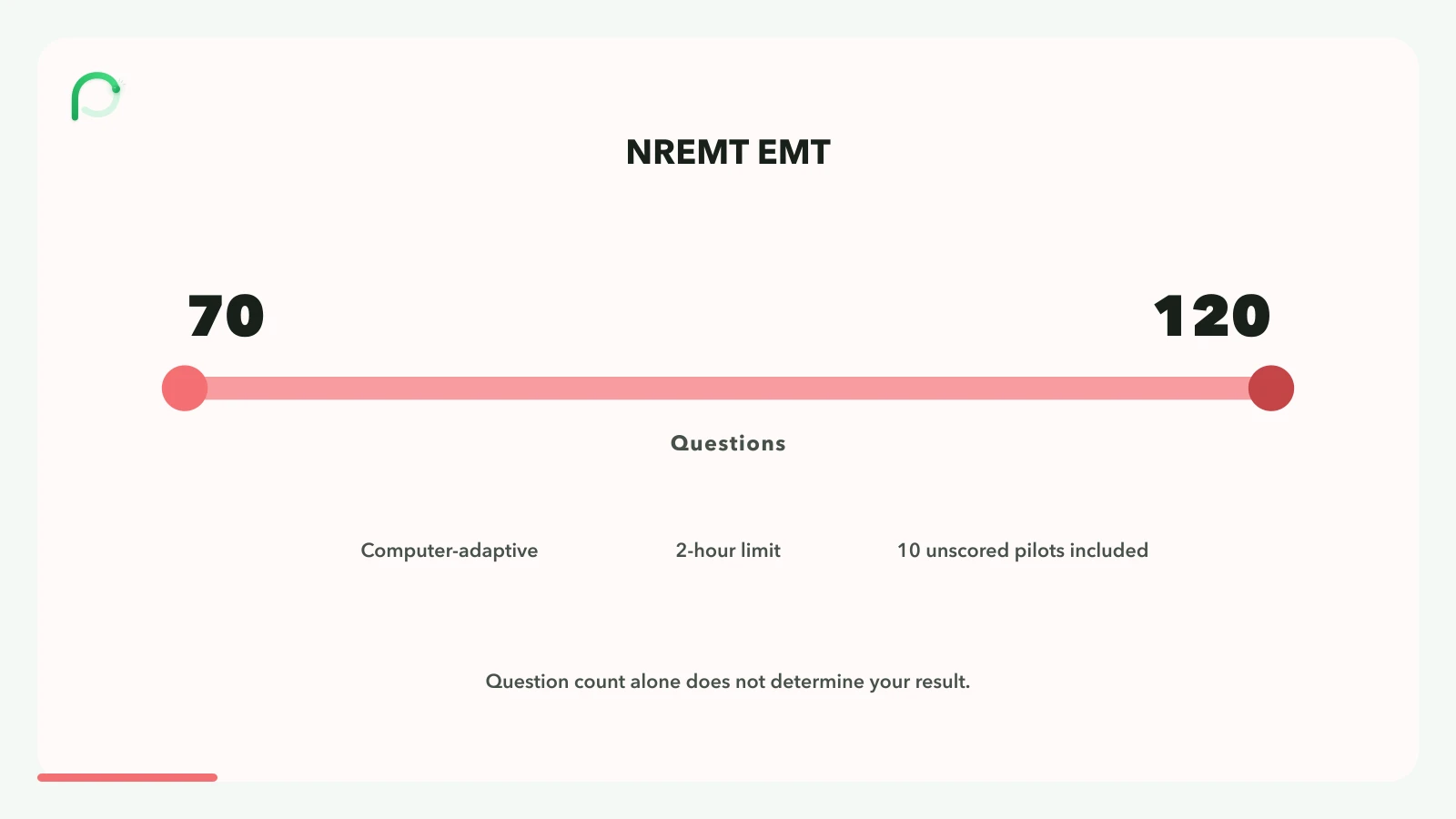
The total is 70–120 items
The updated NREMT EMT exam uses a variable total length: at least 70 items and no more than 120 items within a two-hour limit. When preparing, practice making a supported EMT decision without watching the counter, because no candidate can choose or infer the final length in advance.
The updated examination launched April 7, 2025. The 70–120 range comes from the current National Registry EMT Examination Specifications, not from an estimate based on older versions.
The range refers to items delivered during the exam. It does not mean every candidate receives 120 questions, and it does not promise that an exam will end as soon as item 70 appears.
The 10 pilot items are already included
The exam includes 10 unidentified unscored pilot items. Those 10 are part of the 70–120 total range.
Correct:
The exam contains 70–120 total items, including 10 unscored pilots.
Incorrect:
The exam contains 70–120 scored items plus 10 unscored pilots.
Pilot items allow the National Registry to collect data about whether an item may be suitable for future scored use. The scored items use dichotomous scoring—each complete response is correct or incorrect, with no partial credit—while the 10 pilots do not affect the candidate's score. Pilot items are not identified during the exam.
That means you should treat every item as if it counts. Trying to label an unfamiliar item as a pilot can lead you to dismiss a scored question, and trying to identify pilots afterward cannot produce a dependable raw score.
Why candidates receive different totals
The EMT certification examination is computerized adaptive. After an initial set of items, the system targets items at or above its current estimate of the candidate's ability. At the 70-item minimum, it can stop if it can make a pass or fail determination with 95% confidence.
If the system has not reached a determination at the minimum, the administration can continue until it can, until 120 items are reached, or until the maximum time is reached. The separate NREMT adaptive-test guide explains that process and the 95% confidence language in context.
The practical point is simple: prepare to answer the current item carefully, whether the exam is at 71 or 111. Rehearse a consistent cue-to-action process across mixed questions so a changing total does not change your method.
Item count does not reveal the result
A variable item count cannot tell you whether you passed or failed. Seventy is the minimum and 120 is the maximum, but either stopping point can be associated with either outcome. The official result—not the number on the counter—answers the result question.
If your exam has already ended, use the focused explanations rather than trying to decode the range:
The same caution applies to felt difficulty, the last question, or a cluster of one topic. None is an authorized score report.
Use the two-hour limit proportionately
Two hours across the possible range produces very different rough averages:
- at 70 total items, about 103 seconds per item.
- at 120 total items, about 60 seconds per item.
Those figures are orientation, not a pacing rule. Items vary by length and response demand, and the final total is unknown while you test. Spending exactly the same number of seconds on every item would ignore that reality.
Practice three pacing habits instead:
- Read the complete prompt and identify what response is requested.
- Spend enough time to find the controlling cue and evaluate the required options.
- Commit once you have the best supported answer rather than reopening the entire scenario repeatedly.
Build enough endurance to work attentively, but do not make every study session a two-hour simulation. Short sets followed by careful rationale review often reveal more about why an answer failed. Review the reasoning behind uncertain answers before adding volume.
Question formats do not change the total range
The current official item types are multiple choice, multiple response, options table, build list, and drag-and-drop. Scored items use dichotomous scoring, so there is no partial credit for a partly correct response; the 10 pilot items remain unscored.
An alternate format is still one item in the exam count. Its presence does not show whether it is scored, does not carry a published result signal, and does not mean the exam is about to stop.
The NREMT question-types guide gives a practical check for each format without reproducing live exam content.
Prepare for a range, not one expected stop
The best planning assumption is that your exam may continue anywhere within the official range. If it ends at 70, you will have spent attention on the work in front of you rather than hoping for a short test. If it continues, the additional items will not automatically feel like a crisis.
Use what to study for the NREMT EMT exam to keep the current domain map in view. In practice:
- vary the length of question sets.
- include all five current domains.
- integrate pediatric patient-care decisions throughout.
- use current response formats; and
- review every rationale, including correct guesses.
Do not use recalled or copied live items to imitate the exam. Original questions tied to current official objectives are safer and more useful for learning transferable decisions.
Before test day, complete one varied set without checking progress after every item. The number to remember is the official range—70–120 total, with 10 unscored pilots already inside it—not a target stop that supposedly predicts your result.
Trust the source
Official sources
Exam policies can change. Use these primary sources for the most current details.
- National Registry Emergency Medical Technician Examination SpecificationsNational Registry of Emergency Medical Technicians↗
- The Updated EMR and EMT Certification ExaminationsNational Registry of Emergency Medical Technicians↗
- EMT Candidate Handbook: About the ExaminationNational Registry of Emergency Medical Technicians↗