
NREMT EMT guideExam Format
NREMT Stopped at 70 Questions: Did You Pass?
A 70-item NREMT EMT exam can end in either result. Learn what the minimum-length stop establishes, what it cannot reveal, and what to do while waiting.
Short answer
You cannot know whether you passed or failed from a 70-item NREMT EMT exam. Seventy is the current minimum total length, and the adaptive exam can stop there after reaching a pass or fail determination with 95% confidence. The item count reveals where the exam ended, not which result was reached.
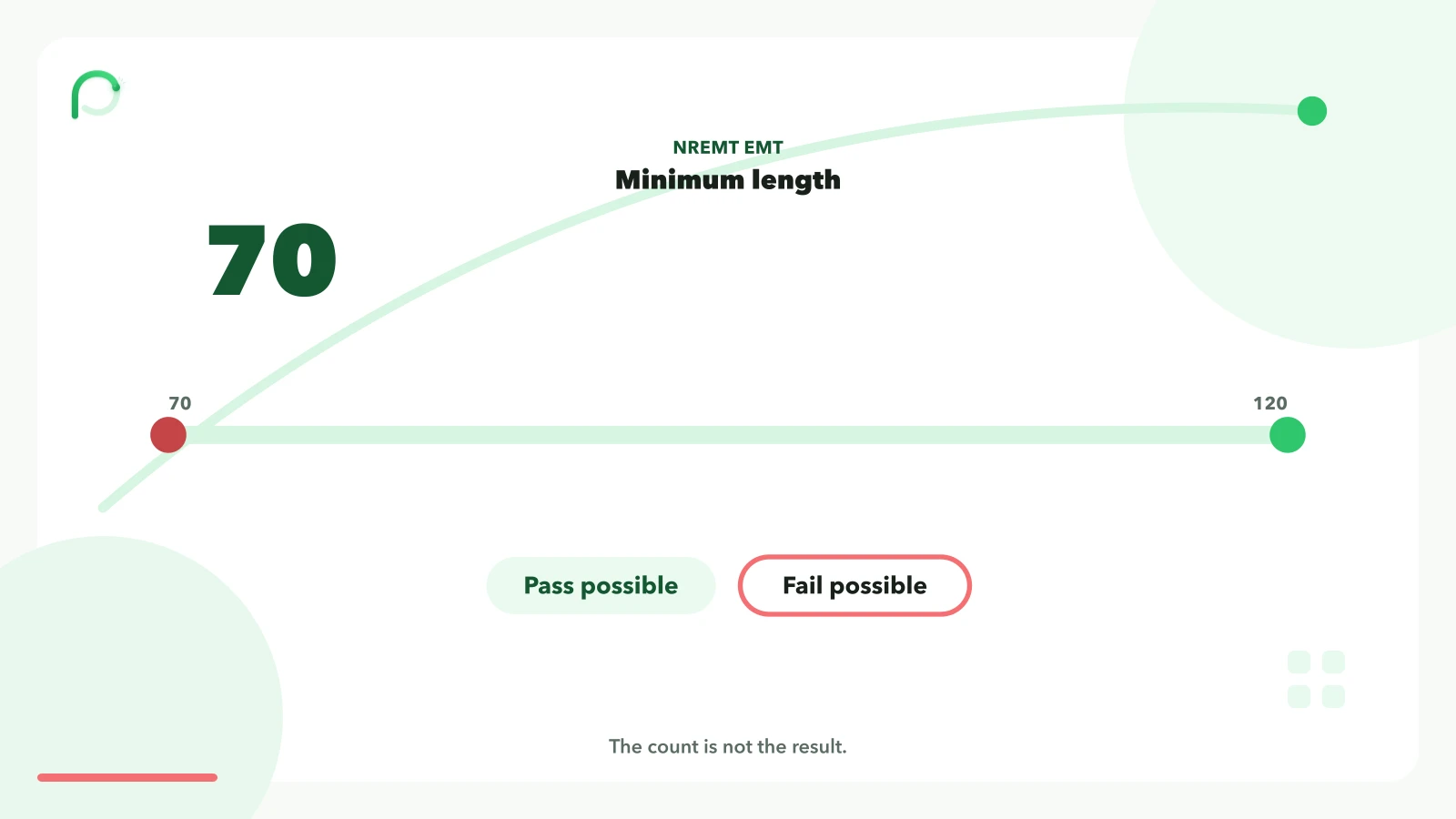
A 70-item stop does not disclose the result
The current NREMT EMT certification exam can contain 70 to 120 total items, including 10 unidentified pilot items that are not scored. Seventy is therefore the minimum total—not 70 scored items plus 10 more. While you wait for the authorized result, try a brief review of familiar questions in the Passy NREMT EMT prep app only if that feels steadier than replaying the exam; the stop at 70 is not evidence that you need a retake.
At the minimum, the adaptive exam can stop after reaching a pass or fail determination with 95% confidence. That determination can be on either side of the standard, so a minimum-length exam is compatible with either result. Read the full explanation of how the NREMT adaptive test works without using that mechanism to forecast an individual outcome.
What 70 questions actually tells you
The item count supports only a few limited conclusions:
- the exam reached the current minimum number of items.
- the 10 unidentified pilot items were included within the total range.
- the adaptive system ended the administration at that point; and
- the number alone does not identify the pass or fail determination.
It does not reveal a percentage correct, a scaled score, how many scored items you answered correctly, or which items were pilots. Because pilot items are not identified, recounting remembered questions cannot separate the scored and unscored portions.
The same restraint applies at the other end of the range. Reaching 120 NREMT items does not prove failure; it only supplies a different fact about where the adaptive exam ended.
Difficulty and item format are not hidden score reports
A common post-exam story says that a short test plus difficult-feeling questions means a pass. The official materials do not provide that as a result rule.
Perceived difficulty is personal. A familiar clinical topic can feel easier than an unfamiliar operations question even when that feeling says nothing reliable about the item's statistical role. The current exam also uses several response formats, so ending on multiple choice, multiple response, an options table, a build list, or drag-and-drop does not disclose the outcome.
Avoid treating any of these memories as a result signal:
- whether the last item felt easy or hard.
- whether the final response was correct.
- whether several questions covered the same broad topic.
- whether the exam seemed to become harder; or
- how your item count compares with another candidate's.
The National Registry does not publish an individual next-item rule that would let a candidate reconstruct the algorithm from memory. A feeling about the test is real; it is not a substitute for the posted result.
Use the official result channel
The EMT Candidate Handbook says results are posted only to the candidate's National Registry account, generally within two business days. It directs candidates to contact the National Registry if a result has not posted after five business days.
Use the NREMT results timing guide for those official windows rather than assuming another candidate's same-day experience sets your deadline. Until the result appears:
- Check the correct National Registry account rather than unofficial prediction methods.
- Do not schedule a retake or interpret a score that has not been issued.
- Write down only broad areas that felt unfamiliar, without recording or sharing recalled exam items.
- Keep work, licensing, and retest decisions tied to the authorized result.
If waiting is making it hard to disengage, do one low-pressure review in the Passy NREMT EMT prep app and then stop. That action can structure the wait, but it should not be treated as preparation for a result you do not yet know.
If the result is unsuccessful
Only an unsuccessful score report creates a reason to interpret the reporting scale or plan another attempt. The NREMT passing-score guide explains the reported 100–1500 scale and the indicated passing point of 950 without converting it to a percentage.
At 70 questions, the accurate answer remains narrow: the current minimum was reached, the exam ended, and the official account—not the item count—will tell you the result.
Trust the source
Official sources
Exam policies can change. Use these primary sources for the most current details.
- National Registry Emergency Medical Technician Examination SpecificationsNational Registry of Emergency Medical Technicians↗
- EMT Candidate Handbook: About the ExaminationNational Registry of Emergency Medical Technicians↗
- The Updated EMR and EMT Certification ExaminationsNational Registry of Emergency Medical Technicians↗