
NREMT EMT guideExam Format
NREMT Went to 120 Questions: Does That Mean You Failed?
Reaching 120 NREMT EMT items does not prove failure. Understand the maximum length, why common exam clues cannot predict a result, and how to wait.
Short answer
No. Reaching 120 items on the NREMT EMT exam does not prove that you failed. The adaptive exam may continue until it reaches a pass or fail determination, 120 total items, or the two-hour limit. Reaching 120 means the administration ran to the current item cap; a maximum-length exam can result in either pass or fail.
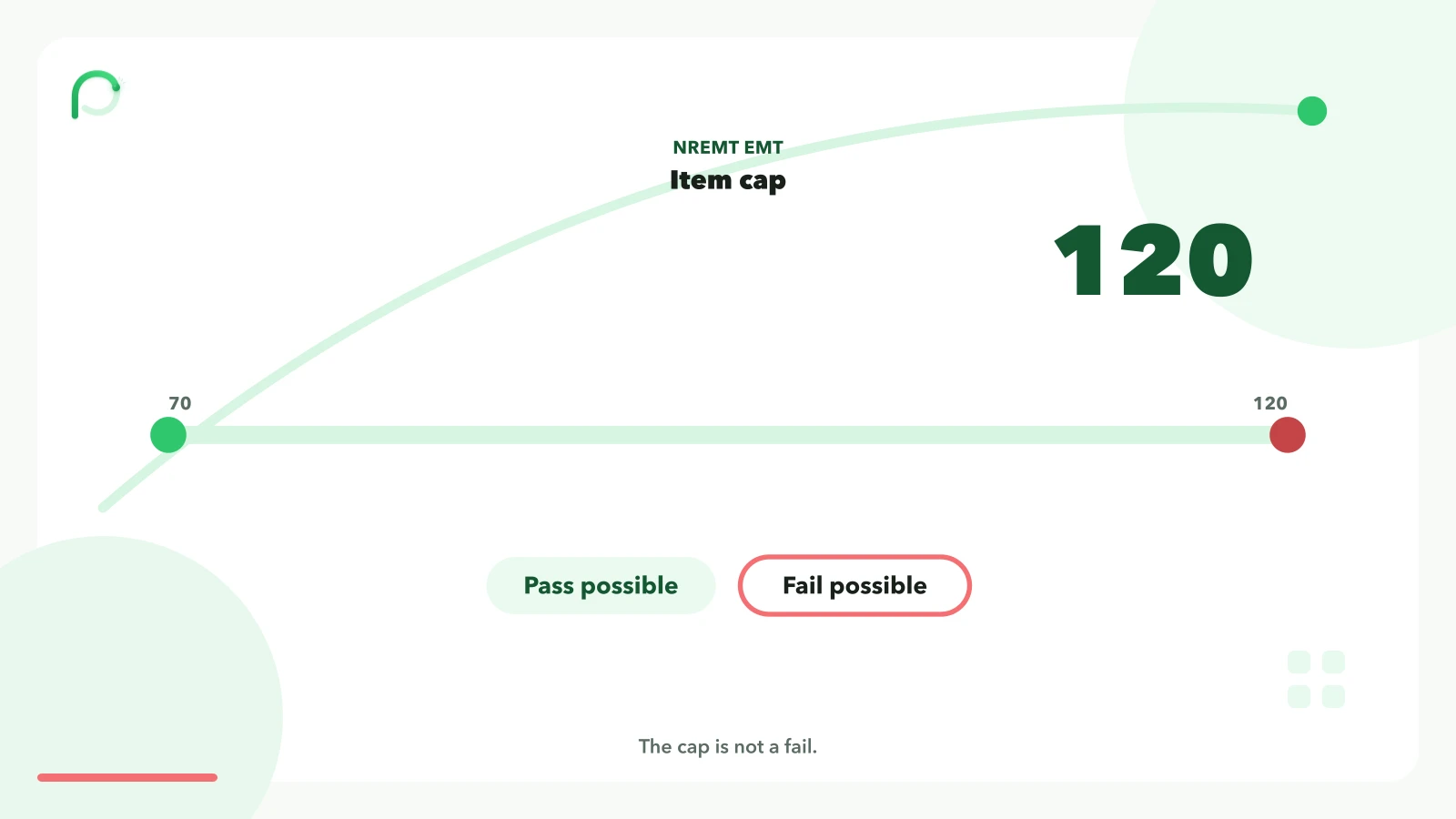
One hundred twenty does not prove failure
The current NREMT EMT examination has a range of 70 to 120 total items, and reaching 120 means your administration ran to that maximum. It does not identify the final pass or fail determination. If doing something familiar would help you leave the exam behind, revisit a few routine EMT questions in the Passy NREMT EMT prep app without treating the session as a response to a known result.
The 120 total includes 10 unidentified pilot items that are not scored. They are part of the 70–120 range, not an extra set added after question 120. Because candidates are not told which items are pilots, the total cannot be reduced to a known count of scored right or wrong answers.
Why an adaptive exam can reach the maximum
The adaptive exam may continue until it reaches a pass or fail determination, the 120-item maximum, or the two-hour limit. Those stopping conditions explain why length can vary, but they do not turn 120 into an individual diagnosis. Saying that a candidate was “definitely failing,” “definitely passing,” or even “exactly borderline” adds a conclusion the item count cannot support.
For the disclosed mechanics and limits of the system, read how NREMT computerized adaptive testing works. The practical point here is simpler: reaching the cap tells you about length, not outcome.
The final question is not a result clue
It is natural to focus on question 120, especially if the response felt obvious, unfamiliar, or incomplete. None of those feelings creates an official result signal.
You cannot reliably determine the outcome from:
- whether the last item seemed easy or difficult.
- whether you believe the last response was correct.
- whether the final format was multiple choice or a technology-enhanced item.
- whether the topics seemed to change late in the exam.
- how many times you felt unsure; or
- another candidate's item count and result.
Adaptive testing uses the scored response record, not a rule that the final item alone decides the exam. The National Registry also does not publish algorithm details that would allow a candidate to label remembered items by exact statistical difficulty.
The same logic applies to the minimum. An exam that stops at 70 NREMT items can also end in either result. “Short means pass” and “long means fail” are opposite versions of the same unsupported shortcut.
What to do after a maximum-length exam
The EMT Candidate Handbook says the result is posted only to the candidate's National Registry account, generally within two business days. If the result has not posted after five business days, the handbook directs the candidate to contact the National Registry.
The NREMT results guide separates that official window from community stories about same-day or overnight posting. A useful waiting plan is:
- Use the authorized account. Avoid registration behavior, email timing, or unofficial websites presented as prediction methods.
- Do not reconstruct all 120 items. The pilots are unidentified, memory is incomplete, and item difficulty cannot be reliably inferred.
- Delay outcome-dependent decisions. Retest scheduling and study-plan changes belong after the posted result.
- Protect exam content. Note broad content areas only; do not record or share recalled questions or answer choices.
If a short activity would keep repeated checking from taking over the day, do one calm refresher in the Passy NREMT EMT prep app and close it. It is equally reasonable to take a complete break.
If you receive an unsuccessful score
An unsuccessful result is accompanied by score information that can support a more specific next step. That is the point to consult how the NREMT score scale works and separate an official report from guesses based on length.
Passing candidates do not receive detailed score information. Unsuccessful candidates receive a score on the 100–1500 reporting scale with the passing point indicated at 950; that number must not be converted into a percentage correct.
Until the account posts the result, 120 establishes only that the exam reached the current maximum. It does not establish failure.
Trust the source
Official sources
Exam policies can change. Use these primary sources for the most current details.
- National Registry Emergency Medical Technician Examination SpecificationsNational Registry of Emergency Medical Technicians↗
- EMT Candidate Handbook: About the ExaminationNational Registry of Emergency Medical Technicians↗
- The Updated EMR and EMT Certification ExaminationsNational Registry of Emergency Medical Technicians↗