
NREMT EMT guideScores & Results
NREMT Passing Score: What 950 Means
Understand the NREMT EMT 100–1500 unsuccessful-candidate score scale, the indicated 950 passing point, and why the number is not a percentage correct.
Short answer
For an unsuccessful NREMT EMT result, the reported score uses a 100–1500 scale and shows the passing point at 950. That 950 is a scaled reporting point, not 95%, 950 correct answers, or a percentage-correct conversion. Passing candidates receive a pass result without detailed score information.
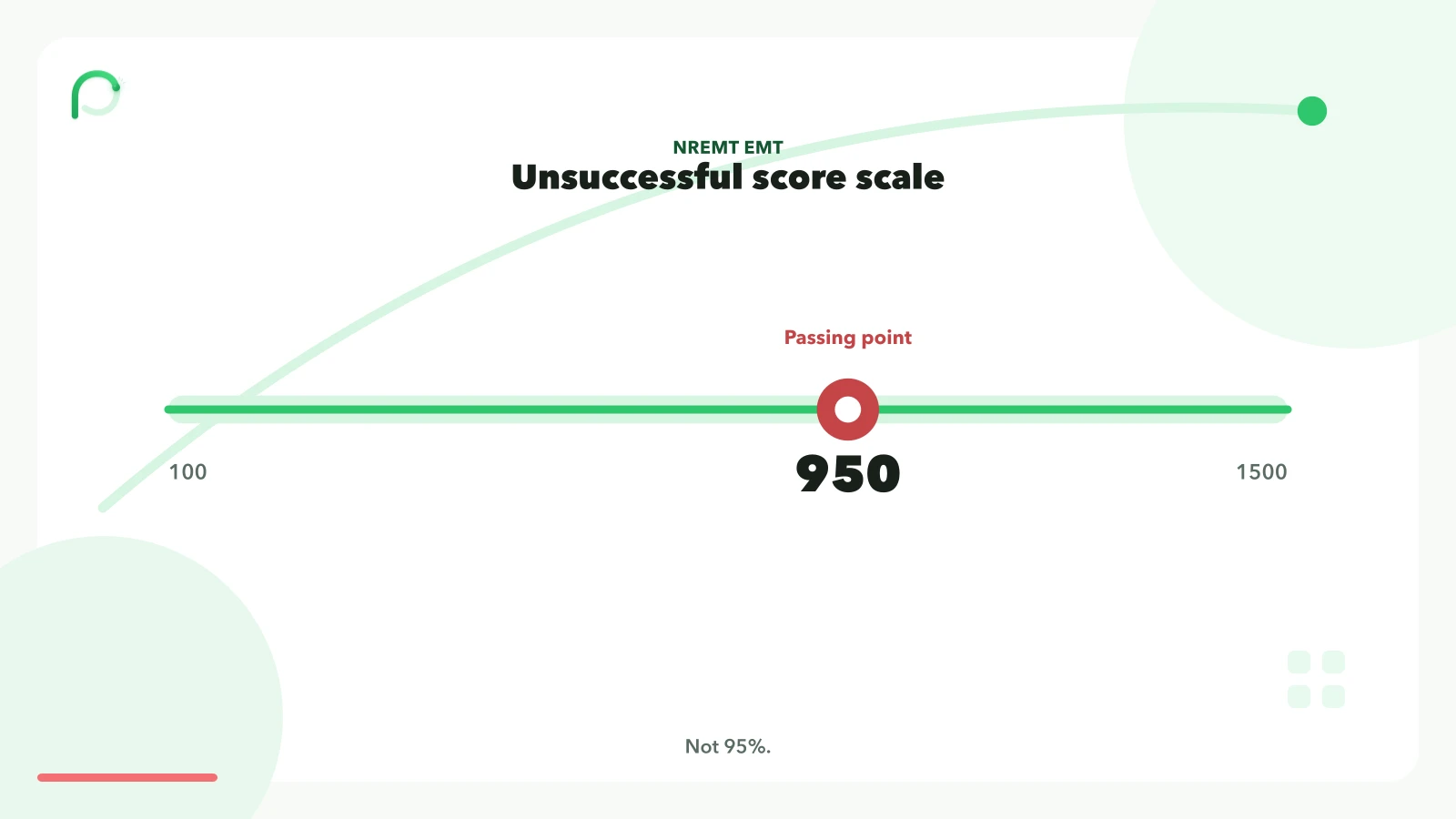
The 950 marker is a scale point, not a percentage
The National Registry reports an unsuccessful EMT candidate's score on a 100–1500 scale, with the passing point indicated at 950. The official scale does not convert 950 into a percentage correct.
The numbers describe a reporting scale. They do not mean:
- 950 correct answers.
- 95% correct.
- a requirement to earn 950 points from individual questions.
- a practice-test percentage that guarantees passing; or
- a count of scored items answered correctly.
The current NREMT EMT exam is computerized adaptive testing with 70–120 total items. Candidates can receive different item paths, and 10 unidentified pilot items within the total are unscored. A simple raw percentage would ignore those boundaries and the adaptive measurement process. If you are preparing rather than reading an issued report, practice exam-style EMT questions with clear explanations in the Passy NREMT EMT prep app instead of chasing a 95% target.
Passing candidates do not receive a detailed score
A passing candidate receives the pass result but not detailed score information. There is no candidate-facing numerical score to use for comparing a stronger pass with a weaker pass.
That distinction answers two different readers:
- If you are still preparing: 950 is not a practice target that can be reproduced as a quiz percentage. Use the current content domains, decision quality, and rationale review to choose study priorities.
- If you received an unsuccessful result: read the number on the official report against the indicated 950 passing point. Do not translate it into an invented percent or an exact number of missed items.
The NREMT results guide explains where results appear and the current timing window. Score interpretation should begin only after the authorized result is posted.
How the adaptive exam reaches a decision
The adaptive exam uses a 95% confidence threshold for its pass or fail determination; that is not 95% correct and not a score the candidate must earn. Read the full NREMT adaptive-test explanation for the disclosed mechanism. Item count, the apparent difficulty of the last question, and a remembered run of topics cannot be converted into the 100–1500 score.
The National Registry does not publish the algorithm detail needed to score recalled items at home. Do not estimate where a single item would fall on the official scale.
What an unsuccessful score can and cannot do
An unsuccessful report gives you one official overall reference: the reported number in relation to the indicated passing point. It confirms the outcome and supplies more information than the item count alone.
It still cannot identify:
- which exam items were the unscored pilots.
- the exact percentage you answered correctly.
- the statistical difficulty of remembered questions.
- a guaranteed outcome on the next attempt; or
- the only content area you should study.
Do not subtract the reported score from 950 and convert the difference into a number of questions. The scale is not presented as one point per item, and the adaptive exam does not give every candidate the same scored form.
Turn the report into proportionate next steps
If the result is unsuccessful, pause before replacing your entire study system. Use the failed-NREMT next-step guide to move from the official result to a measured review plan.
A practical sequence is:
- Confirm the source. Use the result in the National Registry account, not an email delay, item count, or unofficial prediction.
- Read the scale correctly. Compare the issued score with the displayed 950 passing point without converting either number into a percentage.
- Combine evidence. Pair the overall result with patterns from recent practice, rationale notes, and the current EMT domains.
- Choose a limited repair set. Prioritize recurring errors in cue recognition, assessment sequence, treatment and transport, safety, or operations.
- Reassess with new items. Look for more consistent reasoning rather than one reassuring practice percentage.
If you are still preparing, recheck one repeated weak decision before broadening the plan. One focused correction is more useful than trying to “gain” an invented number of scale points. Someone who already has an unsuccessful report should use the scale, the account, and the retake rules, not another practice set, as the next fact.
Use percentages only for the claims they can support
A practice set can show the percentage answered correctly on that set. It may help reveal whether a topic or reasoning pattern needs work, but it is not an official NREMT score conversion and it does not predict certification.
The free NREMT EMT practice questions are best used as a short diagnostic with rationales, not as a pass/fail simulator. After each set, track the reason for each miss.
For an issued unsuccessful result, 950 remains the indicated passing point on the 100–1500 reporting scale. For a passing result, there is no detailed numerical score to interpret.
Trust the source
Official sources
Exam policies can change. Use these primary sources for the most current details.
- EMT Candidate Handbook: About the ExaminationNational Registry of Emergency Medical Technicians↗
- National Registry Scale Score ReportNational Registry of Emergency Medical Technicians↗
- National Registry Emergency Medical Technician Examination SpecificationsNational Registry of Emergency Medical Technicians↗