
NREMT EMT guideStart Here
What to Study for the NREMT EMT Exam
Study the five current NREMT EMT domains, understand their official ranges, and translate the post-April-2025 blueprint into practical priorities.
Short answer
Study the five domains in the current NREMT EMT blueprint: Scene Size-Up and Safety (15–19%), Primary Assessment (39–43%), Secondary Assessment (5–9%), Patient Treatment and Transport (20–24%), and Operations (10–14%). Pediatric patient-care content is integrated throughout. Older Airway, Cardiology, Trauma, Medical, and Operations categories do not describe the current exam blueprint launched April 7, 2025.
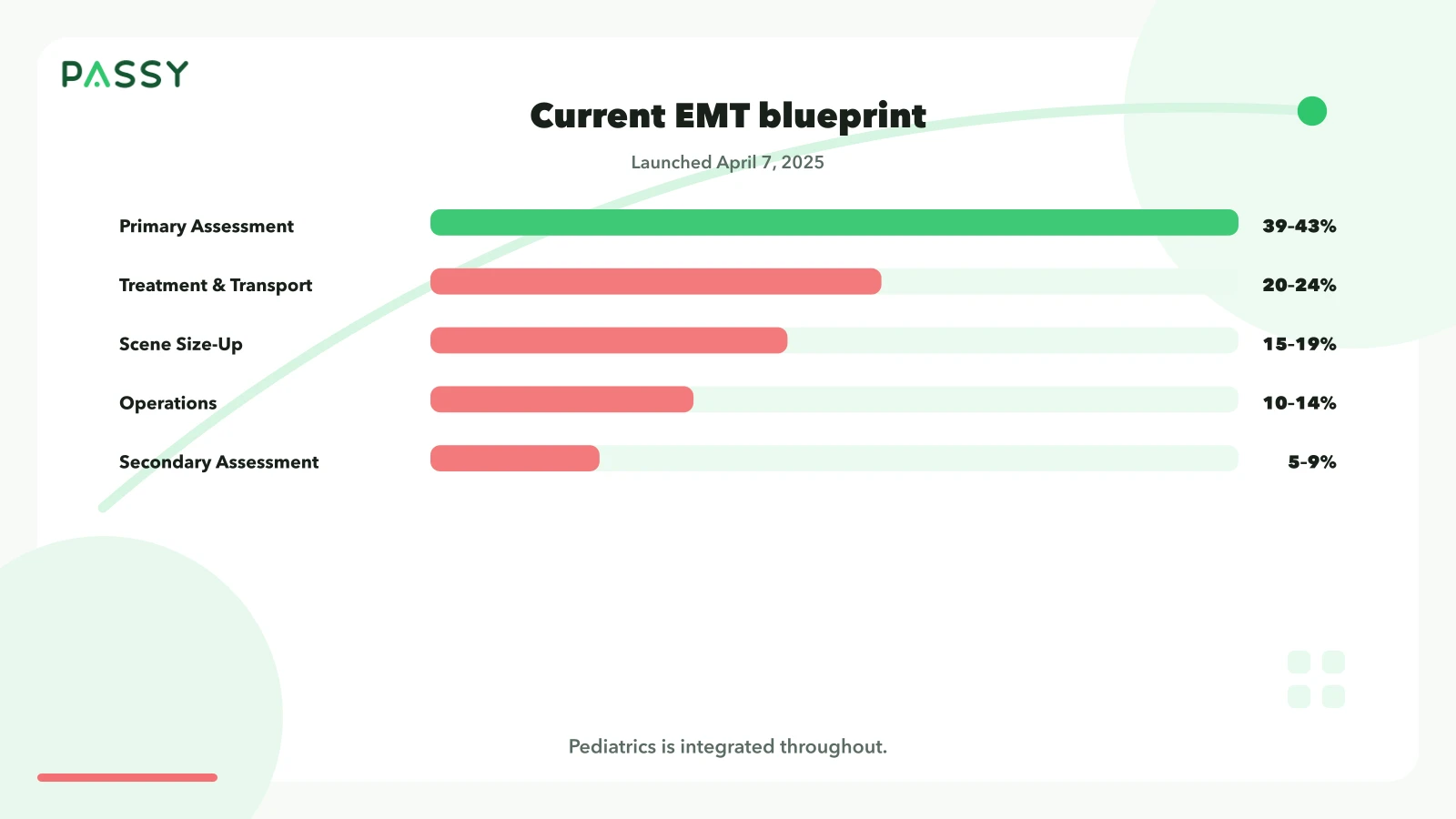
Use the current five-domain map
The five domains describe EMT work as a sequence of safety, assessment, care, transport, and operations decisions. The percentages guide emphasis, but every domain remains testable. Practice one domain at a time in the Passy NREMT EMT prep app to see how its tasks connect, rather than studying a disconnected list of diagnoses.
The updated EMR and EMT certification examinations launched on April 7, 2025, based on a 2023 BLS practice analysis. If a study resource presents Airway, Respiration & Ventilation; Cardiology & Resuscitation; Trauma; Medical/Obstetrics/Gynecology; and EMS Operations as the current five categories, its blueprint is outdated.
That correction does not make airway, cardiology, trauma, or medical knowledge irrelevant. Those clinical topics now appear within job-based domains. For example, airway management belongs under Patient Treatment and Transport, while recognizing an airway threat and urgency belongs within Primary Assessment.
Scene Size-Up and Safety: 15–19%
Study how an EMT prepares before contact and protects responders, patients, bystanders, and the public. The official outline includes using dispatch information, recognizing current and potential hazards, choosing PPE, identifying the number of patients, triaging, and requesting resources.
Practical review should ask:
- What danger must be controlled before patient care begins?
- What PPE fits the known exposure?
- Does the scene suggest additional patients or a need for triage?
- Which resources should be requested now rather than after the scene worsens?
Do not reduce this domain to memorizing a scene-safety phrase. Practice noticing the detail that changes whether approach, entry, or patient contact is safe.
Primary Assessment: 39–43%
Primary Assessment has the largest official range. It covers rapport and communication, general impression, level of consciousness, airway, breathing, circulation, chief complaint, life threats, baseline vital signs and diagnostic testing, and the need for rapid treatment, transport, or additional resources.
The practical implication is that your study should repeatedly connect a finding to urgency. Knowing a normal range or naming a symptom is not enough if you cannot decide what must happen first.
Review scenarios by asking:
- What is the immediate threat?
- Which finding establishes that threat?
- What intervention or resource cannot wait?
- Does the patient need rapid transport?
Because this domain spans many patient types, use focused Primary Assessment practice in the Passy NREMT EMT prep app to expose missed cues, then return to them later in mixed work.
Secondary Assessment: 5–9%
Secondary Assessment has the smallest range, but it still tests purposeful information gathering and reassessment. The official tasks include focused physical assessment, interviewing, past medical history, and revisiting previous findings and interventions to identify change.
Study how the patient's presentation determines the depth and direction of assessment. A focused history or examination should answer a care question, not delay treatment of an immediate threat. Reassessment should compare findings over time and determine whether the plan remains appropriate.
Avoid interpreting 5–9% as “safe to skip.” Missing a narrower domain can also weaken treatment choices that depend on accurate follow-up findings.
Patient Treatment and Transport: 20–24%
This domain includes airway, ventilation, and oxygenation management; cardiovascular and circulatory care; motion restriction; medication administration; interventions for special populations; transport; and communication of pertinent patient information.
This is where many familiar topic labels reappear as actions. Instead of studying “cardiology” only as facts, connect the presentation to permitted EMT interventions, urgency, transport destination or priority, and communication. Instead of treating “trauma” as a separate blueprint category, follow the case from hazard recognition and primary assessment through treatment and movement.
Use current education materials and local protocols appropriately. Exam preparation should remain within the EMT scope represented by official materials and does not override agency medical direction or real-world protocol.
The how-to-study NREMT guide gives a source-to-practice loop for turning these treatment objectives into transferable decisions.
Operations: 10–14%
Operations is broader than ambulance trivia. The official outline includes equipment readiness, medication and supply inventory, documentation, and the well-being of responders.
Study the reasons behind operational actions:
- equipment checks prevent an unavailable or unsafe intervention.
- inventory supports readiness for the next call.
- accurate documentation preserves pertinent patient-care information; and
- responder well-being affects safe performance.
Operational questions may feel less familiar than clinical scenarios, which is precisely why they should appear in mixed review rather than in one forgotten final chapter.
Integrate pediatrics into every domain
Pediatric patient-care items are integrated throughout the examination content; pediatrics is not a sixth domain or a separate percentage row. Build pediatric variation into each area:
- scene and caregiver dynamics in Scene Size-Up and Safety.
- age-appropriate observations and life-threat recognition in Primary Assessment.
- focused history and reassessment in Secondary Assessment.
- airway, medication, movement, communication, and transport in Patient Treatment and Transport; and
- equipment readiness and documentation in Operations.
This structure prevents the common mistake of completing one pediatric unit and then practicing only adult scenarios. Compare adult and pediatric cues while practicing each domain in the Passy NREMT EMT prep app so age changes become part of the decision rather than a separate memorized category.
Match content study to the current exam
The current EMT exam is a computerized adaptive test with 70–120 total items, including 10 unidentified unscored pilot items within that range, and a two-hour limit. The official item types are multiple choice, multiple response, options table, build list, and drag-and-drop. The current NREMT question-types guide explains the response implications, including all-or-nothing scoring.
Content percentages do not tell you the exact number of scored items you will see in each domain on an individual adaptive administration. Use them to avoid an unbalanced plan, not to calculate a personal question quota.
Start with broad coverage, give Primary Assessment and Patient Treatment and Transport recurring space, and keep all five domains in rotation. The 20 free NREMT EMT practice questions cover all five domains with a rationale for every answer, so they make a quick first check; the set is not weighted like the real exam. The NREMT EMT study-plan guide shows how that rotation changes with two, four, or six weeks available.
After several mixed sets, let repeated evidence adjust the blueprint-based starting point. If one decision pattern remains unstable, return to your missed questions in that domain in the Passy NREMT EMT prep app, then confirm the improvement in a later mixed set.
Trust the source
Official sources
Exam policies can change. Use these primary sources for the most current details.
- National Registry Emergency Medical Technician Examination SpecificationsNational Registry of Emergency Medical Technicians↗
- The Updated EMR and EMT Certification ExaminationsNational Registry of Emergency Medical Technicians↗
- EMT Candidate Handbook: About the ExaminationNational Registry of Emergency Medical Technicians↗