
ATI TEAS guideScores & admissions
ATI TEAS Passing Score: What Score Do You Need?
ATI does not set one universal TEAS admissions cut score. Learn how to find the score and attempt policy required by each nursing program.
Short answer
ATI does not define one universal passing score for admission. Each nursing or allied-health school sets its own ATI TEAS cut score and may also decide how attempts, score age, deadlines, and section results are used. ATI does group scores into levels and says your school will most likely want you at Proficient or above, which starts at 58.7% on the TEAS 7 scale. The score you need is the current requirement published or confirmed by every program to which you plan to apply.
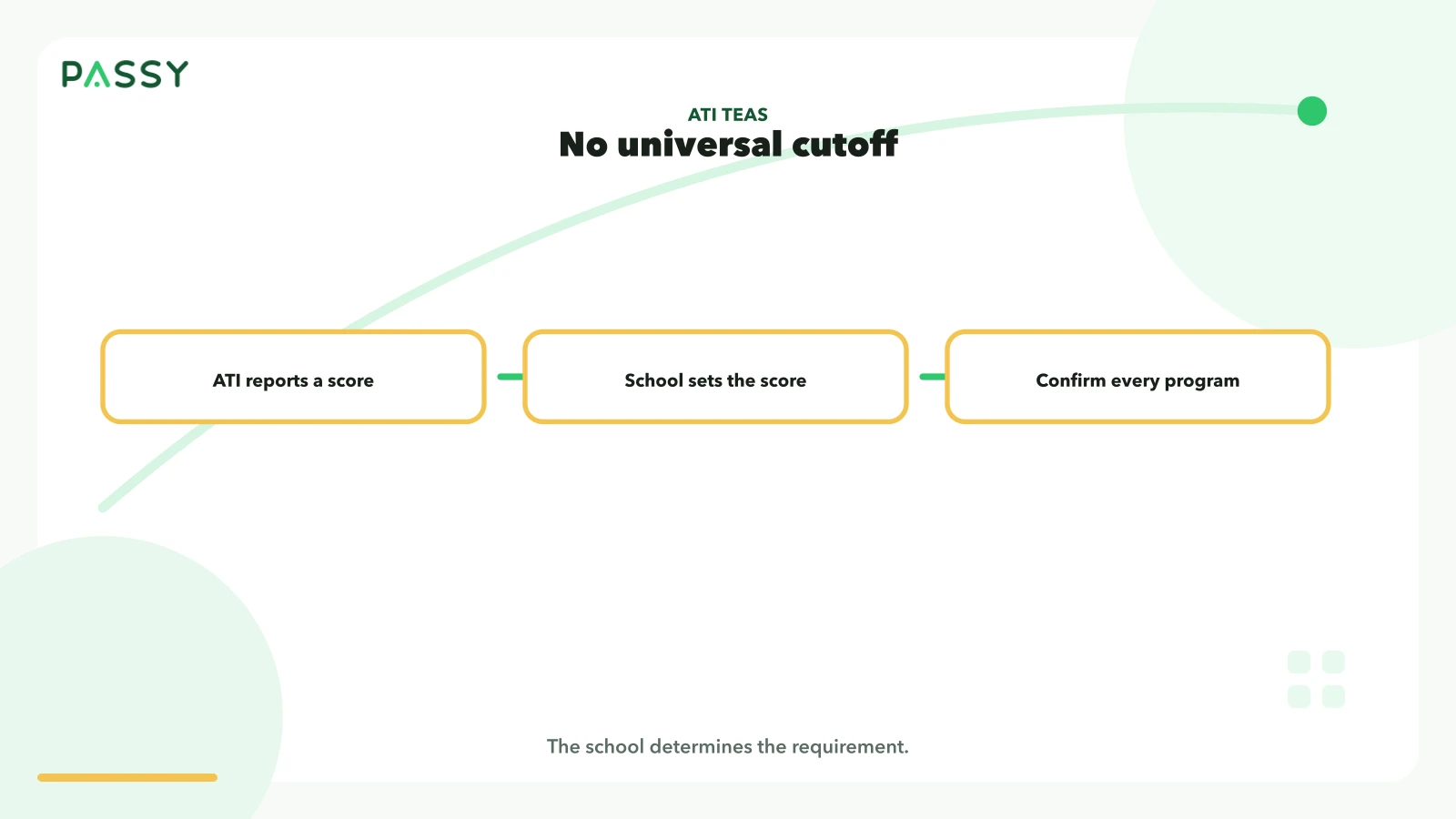
There is no universal ATI TEAS passing score
This guide covers eligibility minimums—the score a program says it will accept—not how competitive your score needs to be among qualified applicants. Confirming that floor gives your planning a real target instead of an internet cutoff. For the next layer, read What is a good TEAS score for nursing school?.
ATI's official guidance is direct: the school determines the score requirement. A percentage presented online as “the passing TEAS score” may describe one program, one applicant pool, or an unofficial recommendation. It is not automatically your requirement.
This matters because two programs can use the same ATI TEAS report differently. One may set a minimum overall score. Another may consider individual content-area scores, the number of attempts, when the test was taken, or the score as one part of a wider admissions process.
After you confirm the actual requirement, plan practice for the sections behind that target in the Passy ATI TEAS prep app rather than chasing an internet cutoff.
How do you find the minimum you must meet?
Check each target program's current admissions information, then ask the admissions office to clarify anything ambiguous. Record the eligibility floor for each application:
- the minimum overall score, if one is required.
- whether any content-area minimums apply.
- which testing methods or locations are accepted.
- how old a score may be.
- how many attempts the program accepts.
- whether the latest, highest, or first attempt is used.
- the score-submission deadline.
- whether the policy applies to your exact program and entry term.
Do not rely on a requirement quoted by a student from a previous cycle. Save the current published policy or written reply for your records.
If several program rules leave you with different deadlines, shape the available time around the confirmed requirements.
Does ATI label scores as proficient or advanced?
Yes. ATI sorts TEAS results into categories it calls Academic Preparedness Levels, and its help article on required scores says your school will most likely want you in the "proficient and above" levels. On the TEAS 7 table that article shows, Proficient covers 58.7% to 79.3% and Advanced starts at 80.0%. That is ATI's general expectation, not a cut score. Each school still sets its own number, and a program can require more than a level label or weigh the score within a competitive admissions process. All five levels and their ranges are in What is a good TEAS score?.
How the TEAS total score works
ATI converts your raw score to an adjusted total score through equating, so forms of different difficulty can be compared. The total is reported on a 0% to 100% scale. Reading, Math, Science, and English each get their own adjusted score, and those four content-area scores do not add up to the total. ATI's sample report also notes that no total score is given if you do not complete all four content areas.
The ATI TEAS score-report guide explains the overall, content, and sub-content information you may see.
Is the minimum the same as a competitive score?
No. A minimum is the lowest score a program says it will accept under a stated rule. Meeting that rule makes you eligible; it does not describe how applicants are ranked afterward.
If you already meet every confirmed minimum, stop here for eligibility purposes and use What is a good TEAS score for nursing school? to decide whether a higher score would materially help your application.
What if you are applying to several schools?
Create a simple requirement list with one row per program. If the rules differ, plan around the strictest confirmed requirement that matters to your applications. Also verify whether the same score report can be sent to every program and whether additional transcript fees or deadlines apply.
If a retake could affect timing, use the school's attempt limit and any wait that school sets. ATI's current retake page says ATI does not require a waiting period. The ATI TEAS retake guide is where that rule is explained.
How should you use practice scores?
A score from a short practice set is a study signal, not an admissions result. Use it to identify:
- sections with repeated misses.
- skills that require too much time.
- guessed answers that happened to be correct.
- content you cannot yet explain without notes.
Then return to the official content outline and the requirement set by your school. Avoid converting a small practice percentage into a claim that you are “passing” or “failing.”
Confirm requirements before you test
Confirm the current score and attempt rules with every target program before choosing a testing date or deciding whether to retake. Once you know the real requirement, use the ATI TEAS 7 study guide to build preparation around the official four-section exam rather than an internet cutoff.
Then review the explanations for your weakest section in the Passy ATI TEAS prep app, using those patterns—not a short-set percentage—as the signal.
Trust the source
Official sources
Exam policies can change. Use these primary sources for the most current details.