
ATI TEAS guideSections & content
ATI TEAS Science: What to Study for Version 7
Study the four official ATI TEAS 7 Science areas: Human Anatomy & Physiology, Biology, Chemistry, and Scientific Reasoning.
Short answer
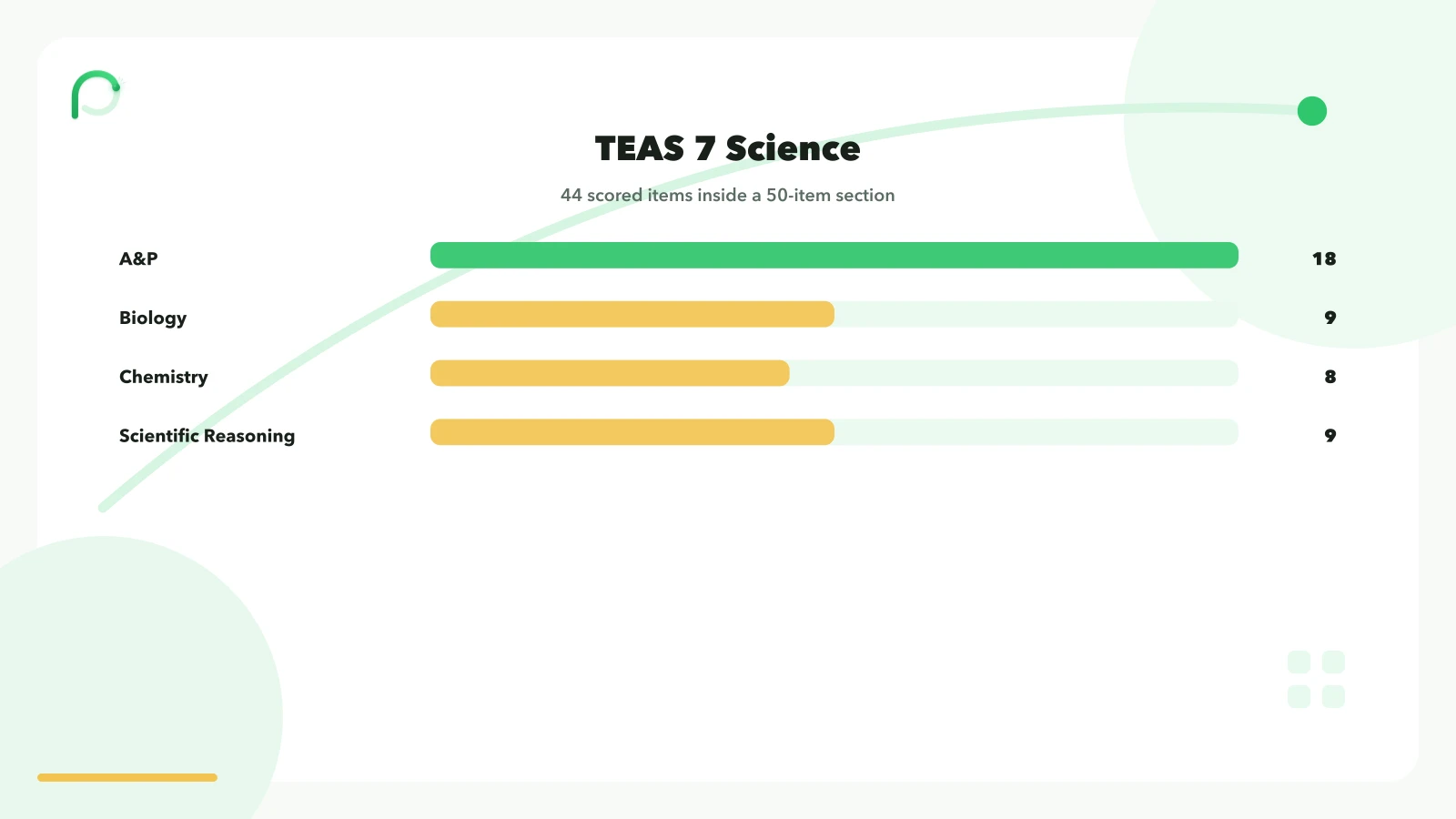
For ATI TEAS Version 7 Science, study Human Anatomy & Physiology, Biology, Chemistry, and Scientific Reasoning. ATI allocates 44 scored Science items across those areas—18 A&P, 9 Biology, 8 Chemistry, and 9 Scientific Reasoning—within a 50-item, 60-minute section.
The official Science allocation
ATI TEAS 7 Science has 50 total items in 60 minutes. ATI's current outline assigns the 44 scored content items this way, so sample all four Science domains in the Passy ATI TEAS prep app within that boundary:
| Science area | Scored items |
|---|---|
| Human Anatomy & Physiology | 18 |
| Biology | 9 |
| Chemistry | 8 |
| Scientific Reasoning | 9 |
The remaining Science items are part of the exam's unscored pretest pool. You will not know which items are unscored.
Use the allocation as a map, then practice one Science relationship at a time in the Passy ATI TEAS prep app before deciding where the next study block belongs.
Human Anatomy & Physiology
A&P is the largest scored Science area at 18 items. It rewards structure-function-regulation thinking across body systems, not isolated label memorization.
Use the dedicated ATI TEAS Anatomy & Physiology guide for the body-system study order, cause-and-effect prompts, and application method. Return to this Science overview to keep Biology, Chemistry, and Scientific Reasoning in rotation so A&P does not consume the entire section.
Biology
ATI's Biology category calls for foundational reasoning about living systems. Useful review includes:
- cell structures and their functions.
- DNA, genes, chromosomes, and protein production.
- mitosis and meiosis.
- inheritance and genetic variation.
- relationships among biological macromolecules.
- microorganisms and basic disease processes.
Practice moving between levels. For example, connect a DNA change to a protein effect, or a cell organelle to the process it supports.
Chemistry
Chemistry review should support clear interpretation, not advanced derivations. Cover:
- matter, elements, atoms, and chemical properties.
- ionic and covalent bonding.
- chemical reactions and balancing concepts.
- solutions, concentration, and solubility.
- acids, bases, and the pH scale.
- physical versus chemical change.
Write units and track what a question asks. A calculator can help with arithmetic, but it cannot choose the correct relationship.
Scientific Reasoning
Scientific Reasoning is not an optional add-on. ATI allocates the same number of scored items to it as Biology.
Practice:
- identifying hypotheses.
- distinguishing independent, dependent, and controlled variables.
- reading tables, figures, and experimental results.
- evaluating whether a conclusion follows from evidence.
- recognizing limitations and alternative explanations.
- applying a scientific model to a new situation.
When reading an experiment, state what changed, what was measured, and what stayed constant before evaluating the conclusion. If Scientific Reasoning misses repeat, practice interpreting data and conclusions in the Passy ATI TEAS prep app before adding another content chapter.
How should you divide Science study time?
Use the item allocation as context, then adjust based on your evidence. A&P deserves sustained attention, but a repeated Scientific Reasoning gap can be more actionable than rereading a familiar body-system chapter.
A useful cycle is:
- review one defined concept.
- answer a small focused set.
- classify each miss as knowledge, relationship, data interpretation, or reading.
- correct the method.
- revisit it later in a mixed set.
Try the free mixed ATI TEAS questions for an initial sample, then return to Passy for the domain that produced the most uncertain misses.
What should you avoid?
Do not treat recalled “exact questions” as a content outline. Live exam items are not the same as ATI's public blueprint, and copied material can be inaccurate or unauthorized.
Also avoid spending all Science time on A&P. It has the largest allocation, but Biology, Chemistry, and Scientific Reasoning together account for more than half of the scored Science content.
Pick one Science relationship today
Make four Science columns and list your strongest and weakest skill in each. Choose one weak relationship—not an entire textbook chapter—for today's review. Then use the four-column map to choose your next Science set in the Passy ATI TEAS prep app.
Trust the source
Official sources
Exam policies can change. Use these primary sources for the most current details.