
PTCB / PTCE guideContent domains
PTCB Medications: What to Study for the PTCE
Domain 1 is 35% of the current PTCE. Study names, classes, indications, interactions, contraindications, doses and forms, adverse effects, and storage. PTCB does not publish a fixed official Top 200 list.
Short answer
PTCE Domain 1, Medications, is 35% of the outline effective January 6, 2026. PTCB asks for generic and brand names, classifications, therapeutic duplications, interactions and contraindications, strengths and doses, dosage forms and routes, handling and duration, side effects and allergies, indications, and stability and storage. Some of those statements are calculation-based. PTCB does not publish a single official Top 200 roster. Study classes and high-use examples, then practice identification—not prescribing.
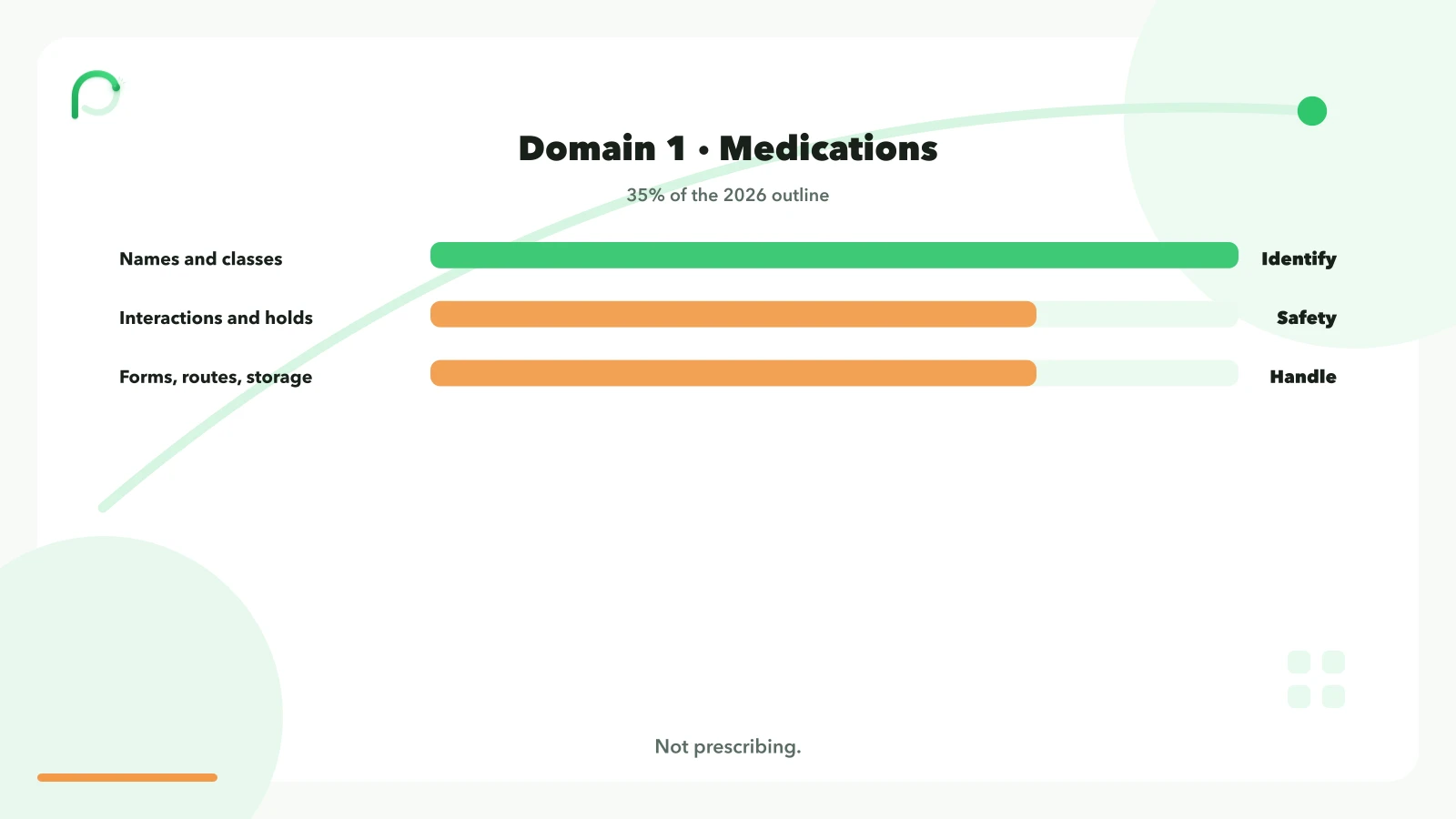
Domain 1 is classification work, not a hidden official list
Medications is 35% of the current PTCE outline. That is the largest domain. Practice medication identification in the Passy PTCB prep app after you can name the knowledge areas, not after you download an unofficial “PTCB Top 200” spreadsheet.
PTCB’s statements cover:
- Generic names, brand names, and classifications
- Therapeutic duplications
- Drug interactions and contraindications (some calculation-based)
- Strengths, doses, dosage forms, routes, handling, and duration of drug therapy (some calculation-based)
- Common and severe side effects, adverse effects, and allergies
- Indications and uses
- Drug stability (some calculation-based)
- Proper storage
This is exam-prep knowledge for technician recognition and pharmacist alert. It is not a license to choose therapy for a real patient.
Study by class, then attach a few high-use examples
Suffix patterns help classification, which the outline actually names:
- ACE inhibitors often end in -pril (lisinopril, enalapril)
- Beta blockers often end in -olol
- HMG-CoA reductase inhibitors often end in -statin
Those patterns are study tools. They are not a claim that every drug in a class behaves identically, and they are not an official PTCB mnemonic sheet.
Therapeutic duplication is a technician catch: two ACE inhibitors on the profile is a pharmacist question, not a “fill both because the directions differ.” Review top drug classes and duplication checks in the Passy PTCE prep app once the suffix patterns feel familiar.
If a resource promises PTCB’s official drug roster, read Do you need the Top 200 drugs? first. It explains why PTCB publishes no such list and includes a sample class table to practice with.
Interactions and contraindications are flags, not dosing projects
A warfarin-plus-regular-NSAID request is a bleeding-risk flag for the pharmacist. An ACE inhibitor plus potassium-sparing overlap is a monitoring flag. The outline wants you to recognize those patterns and involve the pharmacist. It does not ask you to redesign the regimen.
Storage and stability are Domain 1 as well: refrigerator versus room temperature, light-sensitive products, beyond-use thinking where the outline marks calculation-based stability. That is product handling, not compounding from scratch. Compounding as a dedicated PTCE area was removed in 2026. PTCB exam changes in 2026 explains what was removed. When storage and stability facts keep slipping, target storage and stability misses in the Passy PTCB prep app.
How this domain touches the others
Look-alike names and high-alert drugs also appear in Patient Safety. Controlled-substance scheduling is Federal Requirements, even when the product is a medication you also studied for class. Federal Requirements and Patient Safety take those layers.
The PTCB / PTCE study guide shows how to weight 35% against the rest. The useful next step is recognition under a clock, not a longer unofficial list: mix Domain 1 with the other three domains in the Passy prep app for the PTCE so brand/generic drill does not eat the week.
Trust the source
Official sources
Exam policies can change. Use these primary sources for the most current details.