
ATI TEAS guideSections & content
ATI TEAS Math: Formulas, Conversions, and Topics to Know
Review ATI TEAS 7 Mathematics topics, core formulas, unit conversions, and problem-solving habits for Numbers & Algebra and Measurement & Data.
Short answer
ATI TEAS 7 Mathematics covers Numbers & Algebra and Measurement & Data. Know how to work with fractions, decimals, percentages, ratios, proportions, equations, conversions, geometry, tables, graphs, and basic statistics. ATI provides an on-screen calculator for the online exam, but you must still choose the correct setup and units.
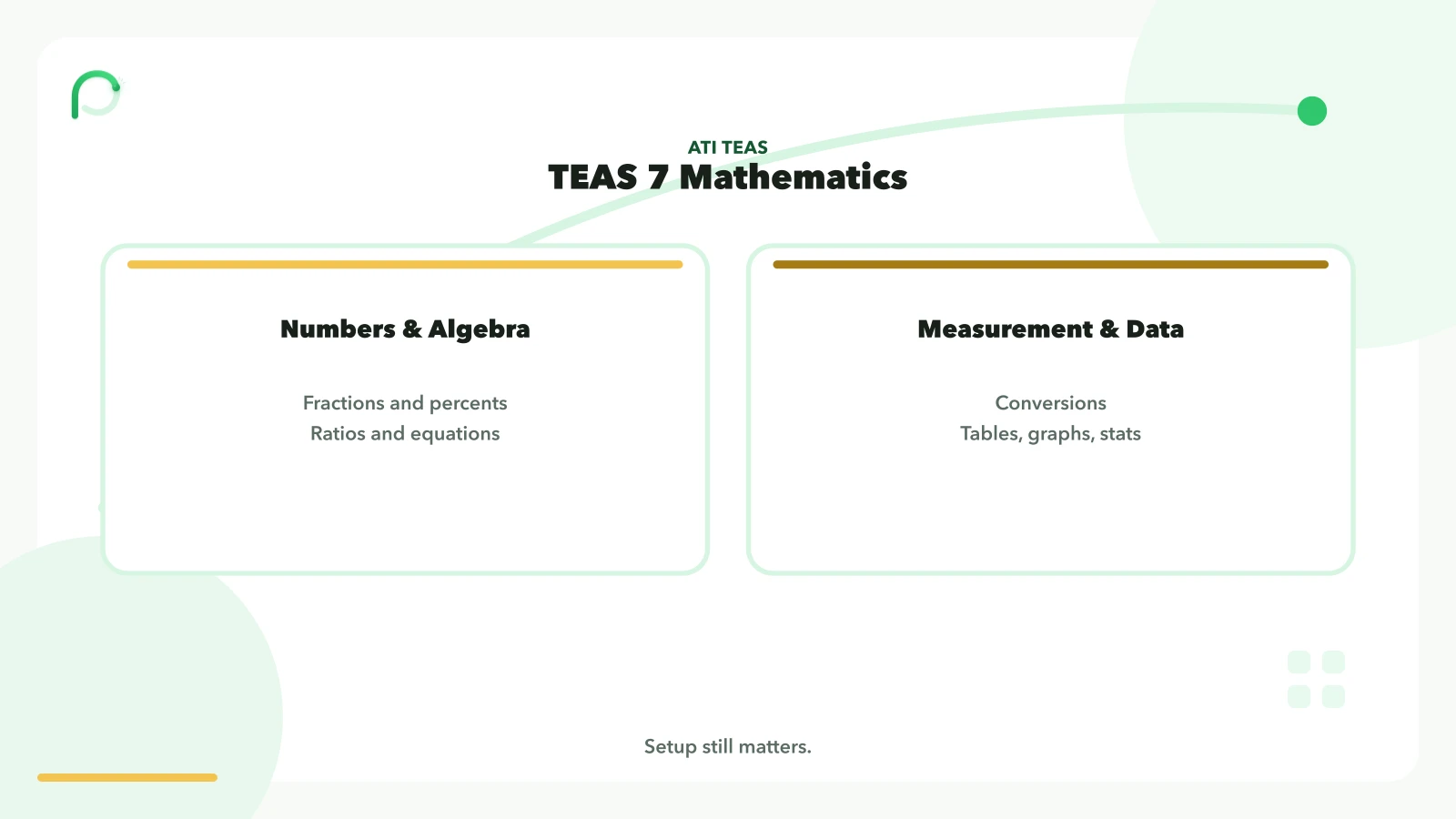
What is on ATI TEAS Math?
The Mathematics section has 38 total items in 57 minutes. ATI's current outline allocates 34 scored content items to the two areas below, so sample both Math areas in the Passy ATI TEAS prep app rather than only familiar formulas:
- Numbers & Algebra: 18 scored items.
- Measurement & Data: 16 scored items.
The topics and allocations above come from ATI. The formula list below is Passy's study guidance—a compact set of relationships worth being able to apply.
To move from a formula list to a method, set up the problem and check the units before the arithmetic.
Numbers and algebra to review
Be ready to:
- order and compare rational numbers.
- calculate with fractions, decimals, and percentages.
- use ratios, rates, and proportions.
- solve one-variable equations and inequalities.
- translate words into mathematical expressions.
- estimate and check whether an answer is reasonable.
Percent relationships
- part = percent × whole
- percent = part ÷ whole
- percent change = change ÷ original amount × 100%
Write the percentage as a decimal before multiplying. For increase or decrease problems, identify the original amount before calculating change.
Ratios and proportions
Keep corresponding units in the same positions:
first quantity / second quantity = matching first quantity / matching second quantity
Cross-multiplication can solve the equation, but unit labels help prevent setting it up backward.
Original setup, not an ATI item: a drink mix uses 3 cups of water for every 2 cups of concentrate. The ratio is water to concentrate, in that order, 3 to 2. You have 8 cups of concentrate. How much water matches it?
3 cups water / 2 cups concentrate = x cups water / 8 cups concentrate. Water stays on top on both sides because the 3 is water and the 2 is concentrate.
3 × 8 = 2x, so x = 12 cups of water. The usual miss is to divide 8 by 3, or to pair water with concentrate on opposite sides of the equation.
Measurement and data to review
Practice:
- converting within and between familiar measurement systems when a relationship is supplied or expected.
- calculating perimeter, area, circumference, and volume.
- interpreting tables, charts, and graphs.
- finding mean, median, mode, and range.
- comparing data and describing relationships.
Geometry relationships
| Shape or measure | Relationship |
|---|---|
| Rectangle perimeter | P = 2l + 2w |
| Rectangle area | A = lw |
| Triangle area | A = ½bh |
| Circle circumference | C = 2πr or πd |
| Circle area | A = πr² |
| Rectangular prism volume | V = lwh |
Use the units the question requests. Area uses square units; volume uses cubic units.
Common conversion habits
Instead of memorizing a long unlabeled list, write conversion factors as fractions so unwanted units cancel. Review common metric relationships:
- 1 meter = 100 centimeters.
- 1 liter = 1,000 milliliters.
- 1 kilogram = 1,000 grams.
ATI’s Version 7 outline also asks you to convert within and between standard (U.S. customary) and metric units. These relationships cover most setups:
| Relationship | Type |
|---|---|
| 12 inches = 1 foot, 3 feet = 1 yard, 5,280 feet = 1 mile | U.S. customary length |
| 16 ounces = 1 pound | U.S. customary weight |
| 8 fluid ounces = 1 cup, 2 cups = 1 pint, 2 pints = 1 quart, 4 quarts = 1 gallon | U.S. customary volume |
| 1 inch = 2.54 centimeters | Between systems (exact) |
| 1 kilogram ≈ 2.2 pounds | Between systems (rounded) |
| 1 mile ≈ 1.6 kilometers | Between systems (rounded) |
| 1 fluid ounce ≈ 30 milliliters | Between systems (rounded) |
If a question gives its own conversion factor, use that one.
Original example, not an ATI item: convert a height of 5 feet 4 inches to centimeters. First stay inside one system: 5 feet × 12 = 60 inches, plus 4 is 64 inches. Then cross systems: 64 inches × 2.54 centimeters per inch = 162.56 centimeters, about 162.6 cm. The usual miss is multiplying 5.4 by 30.48, which treats 4 inches as 0.4 feet.
Can you use a calculator?
ATI states that online ATI TEAS exams provide a calculator within the exam. Candidates should not bring a personal calculator. For paper-pencil administrations, ATI says the proctor provides one.
The calculator does not choose a formula or explain a graph. Practice estimating first so you can catch a misplaced decimal or reversed conversion, then check the setup on your missed Math questions in the Passy ATI TEAS prep app.
How should you practice ATI TEAS Math?
For each problem:
- underline what must be found.
- write the known values with units.
- choose a relationship.
- estimate the likely size of the answer.
- calculate.
- check units and reasonableness.
The free ATI TEAS practice set has 20 questions, including four original Math items. Use them to test setup before speed.
What should go on a formula sheet?
Build your own one-page sheet with:
- relationships you repeatedly forget.
- one worked example for each.
- common units.
- a reminder to estimate and label the answer.
Re-create the sheet from memory rather than only rereading it. Remove formulas once you can apply them reliably, and spend more time on those that still cause setup errors.
Solve three setup problems
Choose one category—percent, proportion, equation, conversion, geometry, or data. Solve three varied problems without looking at a worked example, then explain your setup. Keep the missed method in the next session.
Trust the source
Official sources
Exam policies can change. Use these primary sources for the most current details.