
NCLEX-RN guideScores & Results
What Score Do You Need to Pass the NCLEX-RN? Passing Standard Explained
Understand the current 0.00-logit NCLEX-RN passing standard, why it is not a percentage-correct score, and how CAT makes a pass/fail decision.
Short answer
The current NCLEX-RN passing standard is 0.00 logits through March 31, 2029. A logit compares estimated candidate ability with item difficulty; it is not a percentage-correct score. There is no official rule that you must answer a fixed percentage of questions correctly to pass, and the official result is reported as pass or fail rather than as a score.
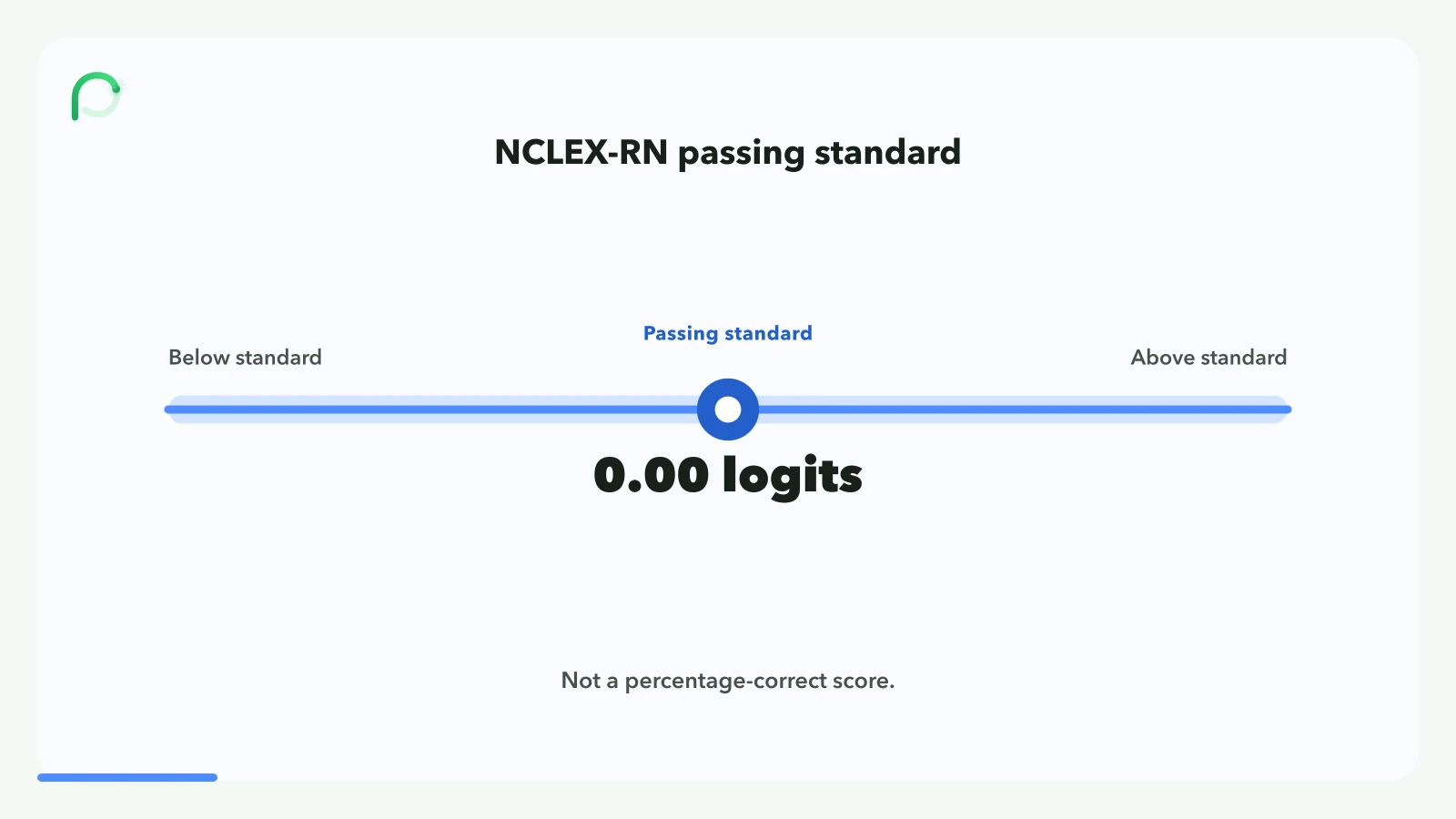
What does 0.00 logits mean?
A logit is a measurement unit used to compare a candidate's estimated ability with the difficulty of NCLEX items. NCSBN's current statistics identify 0.00 logits as the NCLEX-RN passing standard, retained for the three-year cycle ending March 31, 2029.
The zero is an arbitrary point on the measurement scale. It does not mean:
- zero nursing ability.
- 0% correct.
- exactly 50% correct.
- an average score.
- a fixed number of correct answers.
The NCLEX reports a pass/fail decision rather than a percentage score.
What percentage do you need to pass the NCLEX?
NCSBN does not publish a required percentage-correct score for the NCLEX-RN. Because the exam is computerized adaptive testing (CAT), candidates can receive different items at different difficulty levels.
Two candidates could answer a different number or mix of items correctly and still receive the same pass/fail outcome. A raw percentage would ignore item difficulty and the way the adaptive exam updates its estimate after each answer.
Treat claims such as “you need 60%,” “you need 75%,” or “95% means 95% correct” as unofficial. The 95% in the most common stopping rule describes the computer's confidence in its ability estimate—not a required percentage of correct answers.
How does the NCLEX use the passing standard?
After each response, computerized adaptive testing updates an estimated ability level using your scored answers and item difficulty. Pass or fail depends on whether that estimate is above or below the passing standard—not on a fixed percentage correct or a raw item count.
Every NCLEX is scored twice: once by the computer at the test center and again after Pearson receives the exam record. Preparation should focus on explaining safe nursing decisions rather than estimating where an ability estimate would land on exam day.
Do you get a numeric NCLEX score?
No. Your nursing regulatory body sends the official result, pass or fail, within six weeks. NCLEX does not describe any numeric or percentage score for candidates who pass.
Candidates who do not pass receive a two-page Candidate Performance Report. It labels each content area and clinical-judgment category as Above, Near, or Below the Passing Standard, but the exam is not graded in sections: the pass or fail decision comes from overall performance. How to read your Candidate Performance Report explains how to use those labels for a retake.
Does the number of questions reveal your score?
No. An exam can stop at the minimum because the estimate is clearly above or clearly below the standard. A maximum-length exam can also end in either result.
Read what it means when the NCLEX stops at 85 questions and why reaching 150 questions is not an automatic failure for the two common exam-length worries.
The apparent difficulty of your last item is not a reliable clue either. NCLEX explains that candidates cannot accurately identify the statistical difficulty assigned to an item.
What should you use as a preparation target?
Do not build a study plan around an invented percent-correct cutoff. Use practice to find repeat patterns:
- content areas that repeatedly cause uncertainty.
- safety or priority decisions you cannot explain.
- rationales you understand only after reading them.
- clinical-judgment steps that need more deliberate work.
A short practice result cannot predict NCLEX readiness, but it can reveal a useful next study action. Try the free 20-question NCLEX practice set and review the reasoning behind every answer rather than chasing a made-up passing percentage.
When the same uncertainty repeats, repair that decision before choosing the next topic.
Keep the passing standard in perspective
The standard answers one psychometric question: whether the exam has enough evidence that estimated ability meets the entry-level requirement. It does not replace the nursing knowledge, safety reasoning, and clinical judgment you are preparing to apply.
Use the current NCLEX-RN test-plan guide to turn the official content map into practical study priorities. When you choose the next content area, stay with the current test plan rather than a percentage target, and practice that area with rationale-backed NCLEX-RN questions in the Passy NCLEX-RN prep app.
Trust the source
Official sources
Exam policies can change. Use these primary sources for the most current details.