
PTCB / PTCE guideMath & medication study
PTCB Pharmacy Math: Calculations You Need to Know for the PTCE
Current PTCE math lives mainly in Order Entry: days supply, ratios, conversions, concentrations, and dilutions. Alligations were removed in 2026. Original worked examples only. Not a raw-score predictor.
Short answer
The current PTCE does not have a standalone Math domain. Calculation knowledge is marked on the outline, especially in Order Entry and Processing: ratios, proportions, conversions, Sig codes, days supply, quantity, dose, concentration, and dilutions. PTCB removed alligations and nonsterile compounding from the 2026 outline. Use original setups, an on-screen calculator mindset, and unit discipline. Passy will not guess how many scored items will be calculations on your form.
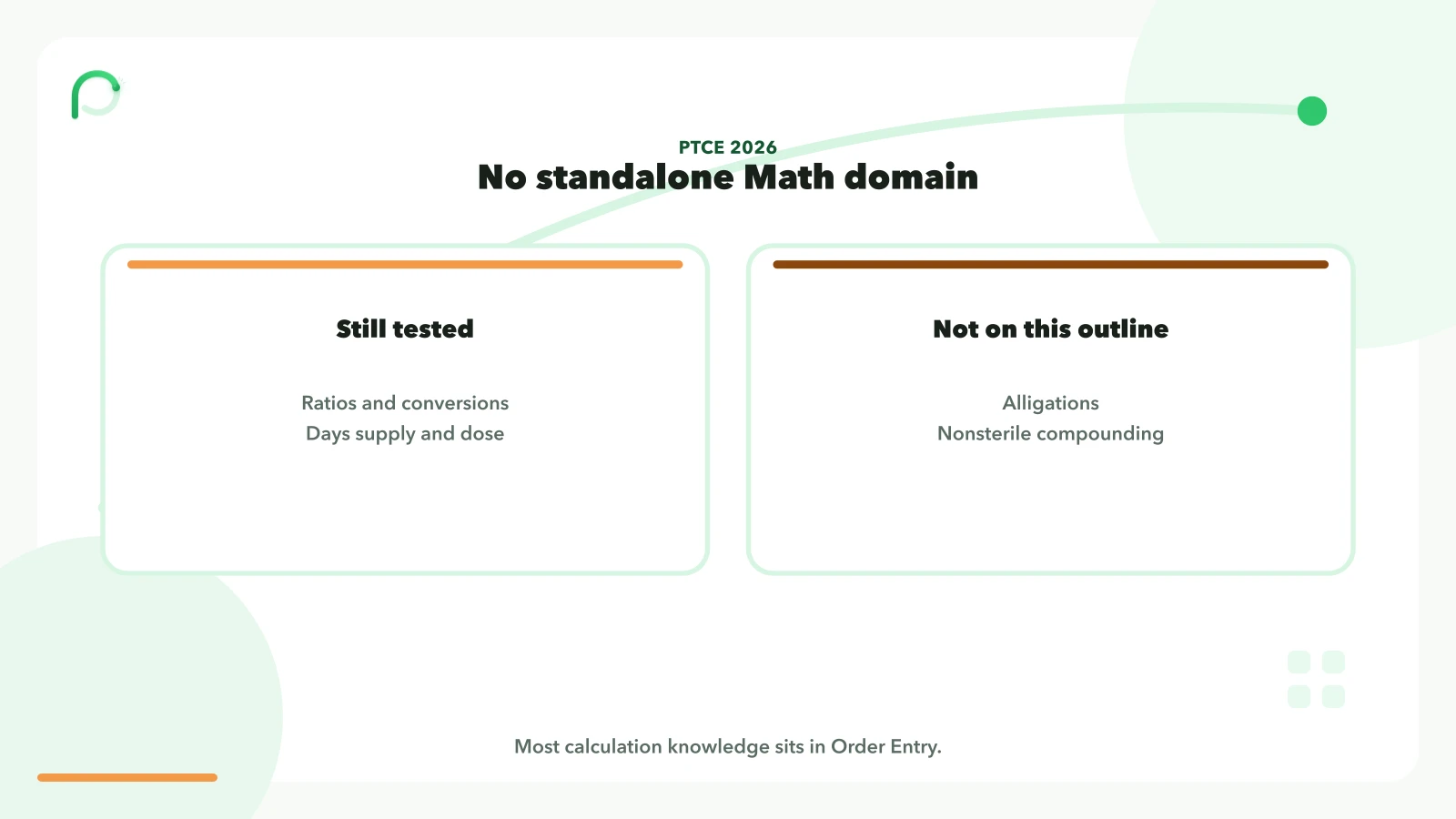
Calculations are still on the exam. Alligations are not.
PTCB marks several knowledge areas with an asterisk as calculation-based. The densest cluster is Order Entry statement 4.1: formulas, ratios, proportions, conversions, Sig codes, days supply, quantity, dose, concentration, and dilutions. Practice those PTCE calculation setups in the Passy PTCB prep app with original numbers, not recalled exam items.
PTCB’s job analysis removed alligations from the calculations statement and removed nonsterile compounding knowledge areas. If a worksheet still opens with a tic-tac-toe alligation grid, it is teaching a previous outline. PTCB exam changes in 2026 is the official deletion list.
These examples are educational exam-prep setups. They are not instructions for a specific patient’s therapy.
Days supply from the Sig
Days supply = quantity dispensed ÷ quantity used per day.
Example. 90 tablets. Directions: 1 tablet by mouth twice daily.
Twice daily is 2 tablets each day. 90 ÷ 2 = 45 days.
Once daily would have been 90 days. Three times daily would have been 30 days. Decode the Sig before you divide. Order Entry & Processing is where b.i.d. and t.i.d. live as language. Practice PTCB pharmacy math, starting with days supply, in the Passy PTCE prep app with clear explanations after each answer.
Ratio-proportion for a liquid dose
Example. Label: 125 mg per 5 mL. Prescribed dose: 200 mg. Find milliliters.
125 mg / 5 mL = 200 mg / x mL
125x = 1,000
x = 8 mL
10 mL would be 250 mg. 5 mL is only 125 mg. Match milligrams to milligrams before you cross-multiply.
Household to metric
If the item gives 1 teaspoon = 5 mL, then 3 teaspoons = 15 mL. If it gives 1 ounce = 30 mL, then 2 ounces = 60 mL. Use the equivalent in the question. Do not import a second unofficial conversion into the same step. If conversions are your weak spot, focus on household-to-metric questions in the Passy PTCB prep app.
Percent strength (w/v)
Example. 2 grams of drug in 50 mL of solution.
Percent w/v is grams per 100 mL.
2 g / 50 mL = x g / 100 mL
x = 4% w/v
That is a remaining concentration setup. It is not alligation of two stock bottles into a third strength.
Dilution with C1V1 = C2V2
Dilutions are still listed in Order Entry statement 4.1. The setup compares the amount of drug before and after you add diluent: starting concentration × starting volume = final concentration × final volume.
Example. How many milliliters of a 10% stock solution are needed to make 200 mL of a 2% solution?
10% × V1 = 2% × 200 mL
V1 = 400 ÷ 10 = 40 mL of stock
Add diluent up to the 200 mL final volume, which is 160 mL here. Check the result by sense: a weaker final strength always needs less stock than the final volume.
Weight-based dose from mg/kg
Example. An order calls for 5 mg/kg for a patient who weighs 44 lb. The item states 1 kg = 2.2 lb.
44 lb ÷ 2.2 = 20 kg
20 kg × 5 mg/kg = 100 mg
Convert pounds to kilograms first, using the equivalent the question gives, then multiply. If the answer choices include 220 mg, that is the trap of multiplying by the weight in pounds.
Time and the on-screen calculator
PTCB Help Center calculator guidance describes an on-screen calculator. A personal calculator is not the default. Every extra tap comes out of the 110-minute exam clock. How long is the PTCB exam? is the timer. Practice moving on from a messy setup so one item does not consume three minutes.
The PTCB / PTCE study guide shows how math fits beside Domain 1. Days supply, ratios, and conversions share the 110-minute clock with every other domain, and one messy days-supply item is not a reason to skip mixed domains the rest of the week: mix calculation questions with the other domains in the Passy prep app for the PTCE after each worked example.
Trust the source
Official sources
Exam policies can change. Use these primary sources for the most current details.