
HESI A2 guideHESI A2 subjects
HESI A2 Anatomy & Physiology: What to Study
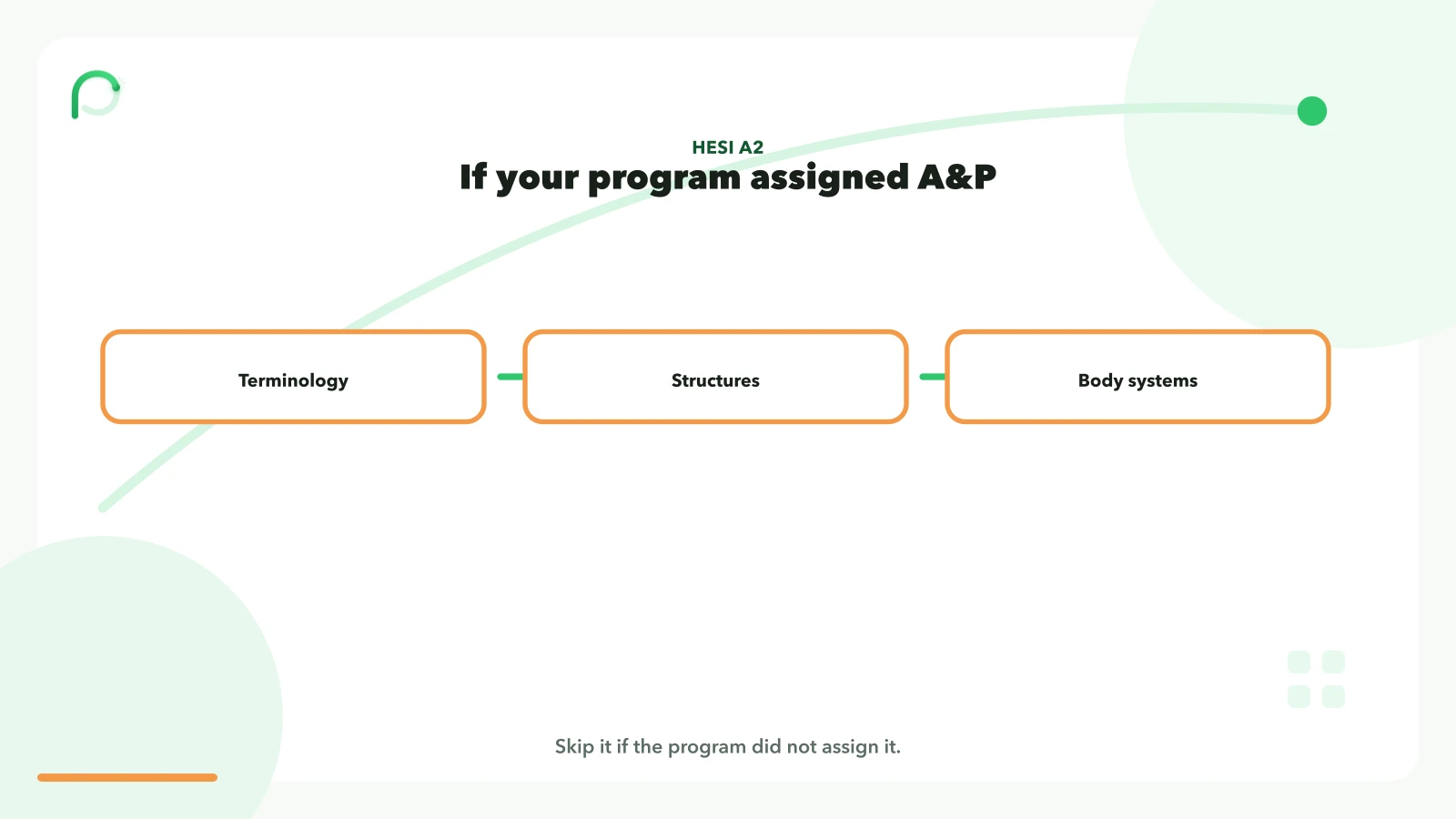
Elsevier’s HESI A2 Anatomy and Physiology exam covers general terminology, anatomical structures, and body systems. Confirm your program assigned it before you build a systems calendar.
Short answer
If your program assigned Anatomy and Physiology, study general A&P terminology, anatomical structures, and body systems—the scope Elsevier publishes for that academic exam. The current sixth-edition Admission Assessment review includes an A&P chapter. Do not treat unofficial “highest yield systems” lists as Elsevier statistics. If your program did not assign A&P, spend that time on the exams it did assign.
Only study A&P if the admissions page assigned it
Anatomy and Physiology is one of Elsevier’s seven academic exams, not a default add-on. Elsevier describes it as general A&P terminology, anatomical structures, and systems, with 25 scored items and about 25 minutes when that exam is administered. Work focused A&P questions in the Passy HESI A2 prep app after you confirm the assignment in writing.
If the school skipped A&P, this page is background—not this week’s calendar. Return to the study guide.
A study framework that stays inside Elsevier’s description
Use three layers. They match the published scope without inventing item frequencies.
Language. Directional terms, planes, and regional names. A question that hinges on proximal versus distal is a vocabulary-of-anatomy item, not a story about a famous surgeon.
Structures. Organs you can name and locate relative to cavities and membranes. If you cannot sketch the path of blood through the heart, you are not ready to interpret a chamber question.
Systems. How a system contributes to homeostasis at a first-year level: what it does, major organs, and a small set of cause-and-effect relationships (for example, diaphragm contraction and thoracic volume).
Passy’s original mixed preview includes heart-chamber and inhalation items as study examples. They are not recalled HESI items and they do not describe official percentages.
How to review without a fake “high-yield” list
Commercial pages rank cardiovascular, respiratory, renal, endocrine, and nervous systems as “most tested.” Elsevier’s public A&P description does not publish that ranking. Cover every major system your review book includes. If time is short, use your own misses—not a blog heatmap—to choose the next system.
A practical loop:
- Name the system and its primary job in one sentence.
- List the major organs.
- Explain one cause-and-effect relationship out loud.
- Answer a small original set.
- Tag misses as term, structure, or relationship.
Check those A&P distinctions with mixed questions in the Passy HESI A2 prep app so you are not only rereading diagrams.
How A&P relates to Biology and Chemistry
Biology in Elsevier’s overview includes cells, molecules, and metabolism. Chemistry includes matter, the periodic table, reactions, and bonding. Those are separate assigned exams. Do not hide from A&P inside a chemistry chapter, and do not skip cells if Biology was assigned.
See HESI A2 Biology and HESI A2 Chemistry only when those exams are on your list. The full map is what is on the HESI A2.
When two science exams are assigned, put the weaker science exam first in the Passy HESI A2 prep app.
What not to memorize
Do not memorize unofficial question wording. Do not treat a 25-item estimate as a promise about your live form. Do not assume A&P is required because “nursing always tests it”—your PDF decides.
If A&P is assigned and still noisy, schedule the next body-systems block in the Passy HESI A2 prep app instead of adding a second illustrated atlas you will not finish.
Trust the source
Official sources
Exam policies can change. Use these primary sources for the most current details.