
HESI A2 guideHESI A2 subjects
HESI A2 Math: What to Study and Practice
Elsevier’s HESI A2 Basic Math exam covers arithmetic, fractions, decimals, ratios, proportions, and household measures. Confirm the exam is assigned, then practice setup under time.
Short answer
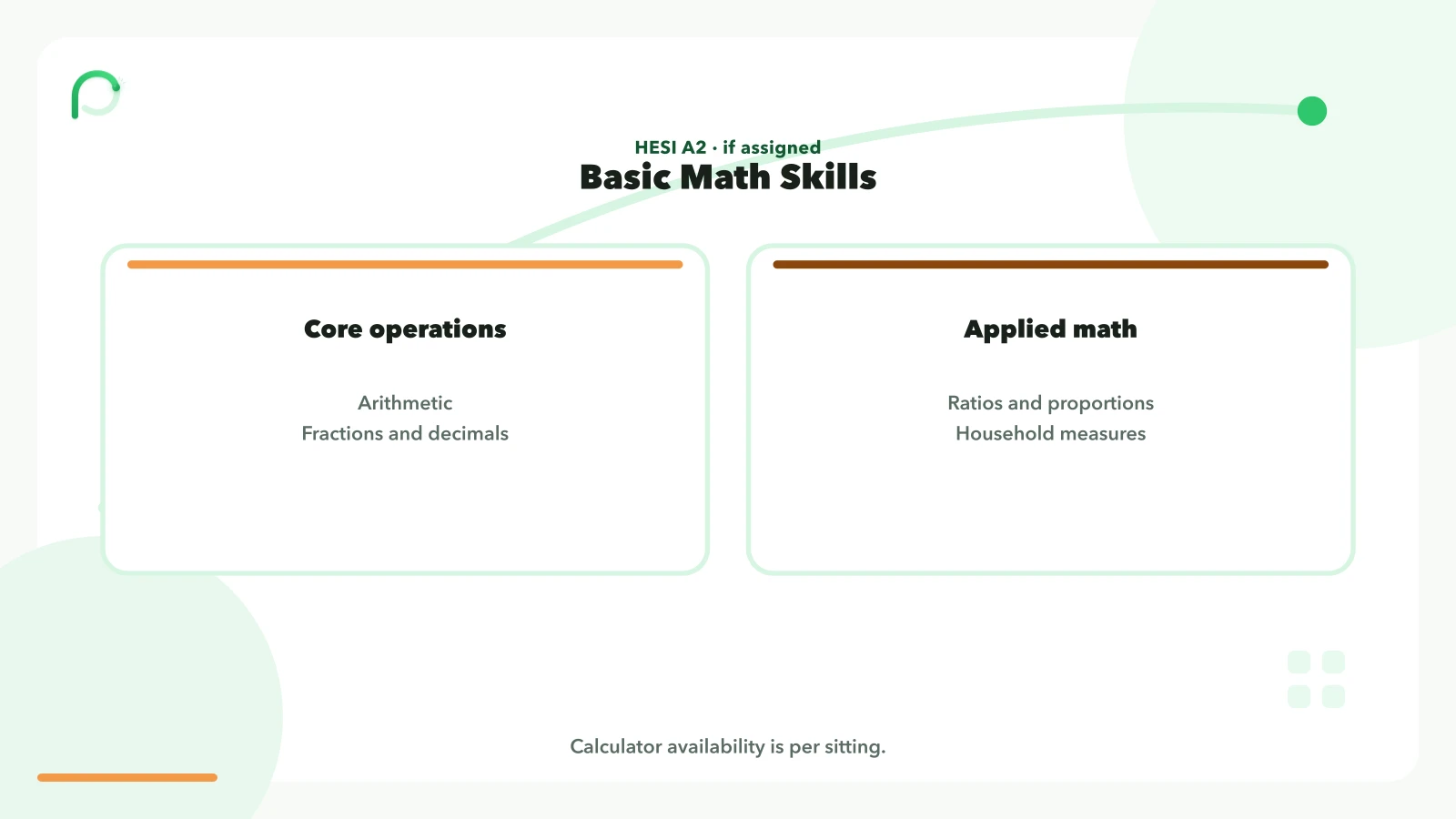
HESI A2 math, when your program assigns the Basic Math Skills exam, is built around arithmetic, fractions, decimals, ratios and proportions, household measures, and related general math facts—the scope Elsevier publishes. Current sixth-edition review materials include a mathematics chapter with worked examples. Practice the setup, not a pile of unofficial “nursing formulas” that are not in that description. Calculator availability is configured per sitting.
Math is an assigned academic exam, not a personality trait
Elsevier’s Basic Math Skills exam is estimated at 50 scored items in about 50 minutes when it is administered. That is a pacing fact for that exam, not proof you will sit it. Work ratio and proportion questions in the Passy HESI A2 prep app after the admissions page lists Mathematics.
What Elsevier says is in scope
The 2022 scientific-evidence paper describes basic addition, subtraction, multiplication, fractions, decimals, ratios and proportions, household measures, and related general math facts. The current Admission Assessment Exam Review highlights step-by-step math explanations and sample problems.
Stay inside that fence:
- operations with whole numbers
- fraction and decimal conversion
- equivalent ratios and missing-value proportions
- household measures and the conversions your review materials actually teach
Original example, not official HESI wording: the item supplies the equivalent 1 cup = 240 mL, and the order needs 1.5 cups. That 240 mL figure is an assumption of this example. If the item gives a different equivalent, use the one in the item.
1.5 × 240 = 360 mL. The answer should be larger than 240 mL because 1.5 is more than one cup. Dividing 240 by 1.5 gives 160 mL, which is smaller and is the inverted setup.
A method that survives the clock
Write the given. Name the unknown. Choose the operation. Estimate whether the answer is larger or smaller than a starting value. Then compute.
Mistakes to check for include inverted ratios, mixed units, and rounding too early.
Confirm calculator rules before you practice only on a phone. Faculty can enable or disable the on-screen tool.
Item-count context is how many questions. Time context is how long.
Then check the same setups in a mixed set, still treating 240 mL as this example’s assumption.
What not to bolt onto the exam
Do not import a full pharmacology dosage curriculum unless your school’s HESI instructions say those items appear. Elsevier’s published Basic Math description is general math used in healthcare education, not a drug-calculation license exam.
Do not collect 40 conversion charts if you cannot complete a proportion with one given equivalent.
The wider plan remains the HESI A2 study guide.
If math is the weak assigned exam, rebuild those setups with missed-question review in the Passy HESI A2 prep app in short daily blocks.
When the appointment is close, keep math inside the same outline; switching tools the night before rarely fixes inverted ratios.
Trust the source
Official sources
Exam policies can change. Use these primary sources for the most current details.