
HESI A2 guideScores & results
HESI A2 Passing Score: What Score Do You Actually Need?
There is no universal HESI A2 passing score. Elsevier publishes interpretive bands for programs; each school sets the admissions number you must meet.
Short answer
There is no single HESI A2 passing score for every nursing program. Each program decides which exams count, whether a composite or section minimum applies, and what number it will accept. For context, Elsevier’s faculty scoring guide, quoted in its 2022 A2 paper, calls 75–79% satisfactory preparation for associate and bachelor’s applicants and 70–79% satisfactory for certificate programs such as practical nursing. Those bands help faculty read academic readiness. They are not an admissions cutoff.
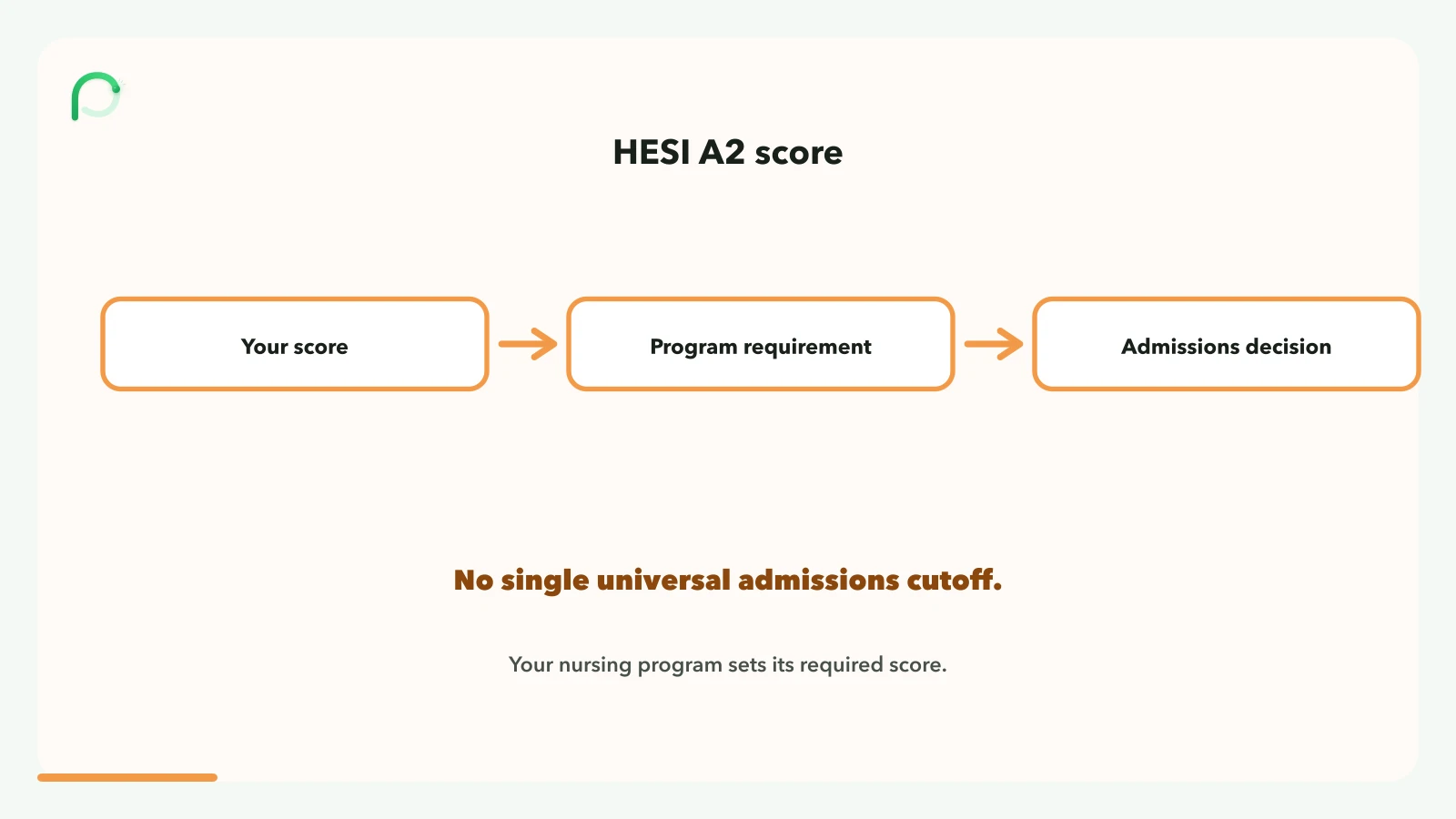
Eligibility is a school rule, not a national HESI pass mark
This page is about the minimum a program says it will accept—not whether a score is competitive among qualified applicants. Confirming that floor gives your planning a real target instead of an internet cutoff. For interpretation after you have a report, use What is a good HESI A2 score?.
What Elsevier actually publishes
Elsevier’s 2022 scientific-evidence paper says each academic exam you take produces its own score, and a composite score averages the exams you completed. The paper also quotes the HESI A2 Faculty Scoring Guide on where satisfactory preparation starts:
- 75–79%: satisfactory for applicants to associate or baccalaureate healthcare education programs
- 70–79%: satisfactory for applicants to certificate programs such as practical nursing or medical assisting
- Below those satisfactory ranges: applicants may need educational remediation to succeed in a program
The same guide calls 80–89% very good and 90–100% excellent. What is a good HESI A2 score? covers those upper bands and competitiveness.
Those bands help faculty interpret academic readiness. They are not a promise that every BSN uses 75%, every PN uses 70%, or that meeting a band admits you. Do not import a HESI Exit Exam conversion scale onto A2 either. A program cutoff remains that program's rule.
Programs studied in that paper used different minimums; Elsevier did not replace school policy with one cutoff. Once you know your program’s number, plan study toward it in the Passy HESI A2 prep app.
How to find the number that actually gates your application
Check each target program’s current admissions information, then ask admissions to clarify anything ambiguous. Record:
- overall / composite minimum, if any
- per-exam minimums (Math and A&P are commonly singled out when they exist)
- which academic exams must be on the same sitting
- accepted testing locations or remote options
- score age
- attempt limits and waiting periods
- whether the latest, highest, or first attempt is used
- the deadline for the score to be on file
Do not rely on a classmate’s cutoff from a previous cycle. Save the current page or written reply.
After the floors are written down, build practice around the exams behind those floors in the Passy HESI A2 prep app.
Composite versus section minimums
A program can require a composite, a set of section floors, or both. Elsevier’s composite is an average of completed exams. If you were not assigned Chemistry, that exam is not part of your average unless the school required you to take it.
A 78% composite with a 68% on a required Math exam can still miss a program that floors Math separately. Read the policy, not only the headline percentage.
HESI A2 results explains where reports typically appear. Retake rules stay school-specific.
If several applications disagree, plan around the strictest confirmed rule that still matters to you.
Practice percentages are not admissions results
A short mixed set is a study signal. It is not Elsevier’s reported score and it is not a school decision. Do not convert it into “I passed HESI.”
When the real floors are known, keep repair inside the exams those floors use.
Trust the source
Official sources
Exam policies can change. Use these primary sources for the most current details.