
NCLEX-PN guideClient Needs
NCLEX-PN Pharmacology: What to Study and How to Think Through Medication Questions
NCLEX-PN Pharmacological Therapies is 10–16% of the 2026 Test Plan. NCSBN does not publish an official drug list. Study hold parameters, teaching reinforcement, and when to notify the RN.
Short answer
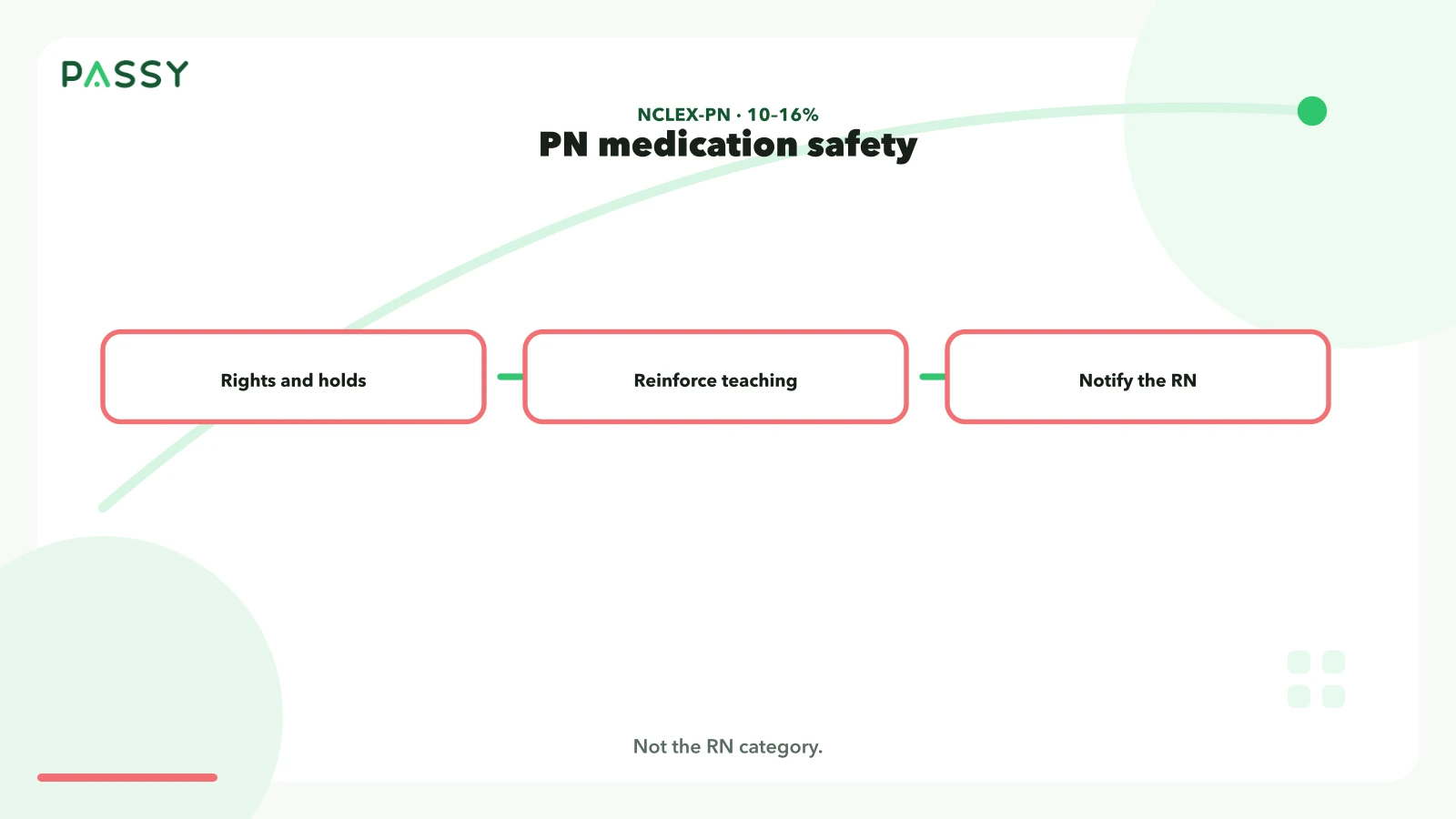
The 2026 NCLEX-PN tests Pharmacological Therapies at 10–16% of the exam. There is no official NCSBN drug list. Study medication safety: rights, hold parameters, common high-alert cues, reinforcing teaching, and notifying the RN rather than independently changing a regimen. PN pharmacology is not the RN category Pharmacological and Parenteral Therapies.
There is no official “meds to know” PDF
NCSBN does not publish a fixed NCLEX-PN drug list. Commercial “top 200 for LPN” pages are study products, not the Test Plan. Put Pharmacological Therapies into practice as safety decisions, not flashcard worship.
The PN label is Pharmacological Therapies. The RN label is Pharmacological and Parenteral Therapies at a different weight. If your deck is built for IV titration and independent blood-product management, you are on the wrong exam. Contrast only: RN pharmacology.
A think-aloud for PN medication items
- Why is this drug in the stem? Class + usual reason.
- What finding makes it unsafe to give? Pulse, blood pressure, glucose, potassium, allergy, pregnancy cue, as applicable.
- What does the LPN do? Hold or give per parameter, document, notify the RN.
- What is too much? Independently substituting another drug, doubling a dose, or ignoring a hold.
Original example (not a live item): apical pulse 52 and new nausea before digoxin → hold, notify. That is Pharmacological Therapies plus Reduction of Risk. Reduction of risk owns labs and monitoring.
What is worth remembering without a fake list
Useful clusters—not an official outline:
- Insulin timing and hypoglycemia treatment when the client can swallow.
- Anticoagulant bleeding cues to report.
- Opioid sedation/respiratory depression: hold, support breathing, get the RN.
- Antibiotic allergy/anaphylaxis: stop the infusion, stay, call the RN.
- Digoxin / beta-blocker pulse parameters.
Ask for a simpler explanation of a hold-parameter miss. Dosage calculation may appear as a calculation item; still show work as a safety check, not as a license to prescribe.
How this Client Need connects
Coordinated Care appears when the issue is “who may give this” or “who must be notified.” Coordinated Care is that page. What's on the exam places the 10–16% range.
Repair medication-parameter misses as a weak area.
The study guide is the sequence.
Keep a weekly mixed set so pharmacology does not become your only Client Need.
Trust the source
Official sources
Exam policies can change. Use these primary sources for the most current details.