
NCLEX-PN guideStart here
What's on the NCLEX-PN in 2027? Test Plan Explained
The current NCLEX-PN Test Plan, which covers every exam date through March 31, 2029, groups items into Client Needs, with Coordinated Care at 18–24%. See every current percentage range and what PN actually tests.
Short answer
The current NCLEX-PN Test Plan, which applies to every exam date through March 31, 2029, including 2027 test dates, tests entry-level LPN/VN practice through Client Needs. Coordinated Care is 18–24%; Safety and Infection Prevention and Control 10–16%; Health Promotion and Maintenance 6–12%; Psychosocial Integrity 9–15%; Basic Care and Comfort 7–13%; Pharmacological Therapies 10–16%; Reduction of Risk Potential 9–15%; Physiological Adaptation 7–13%. Individual CAT exams vary within those ranges.
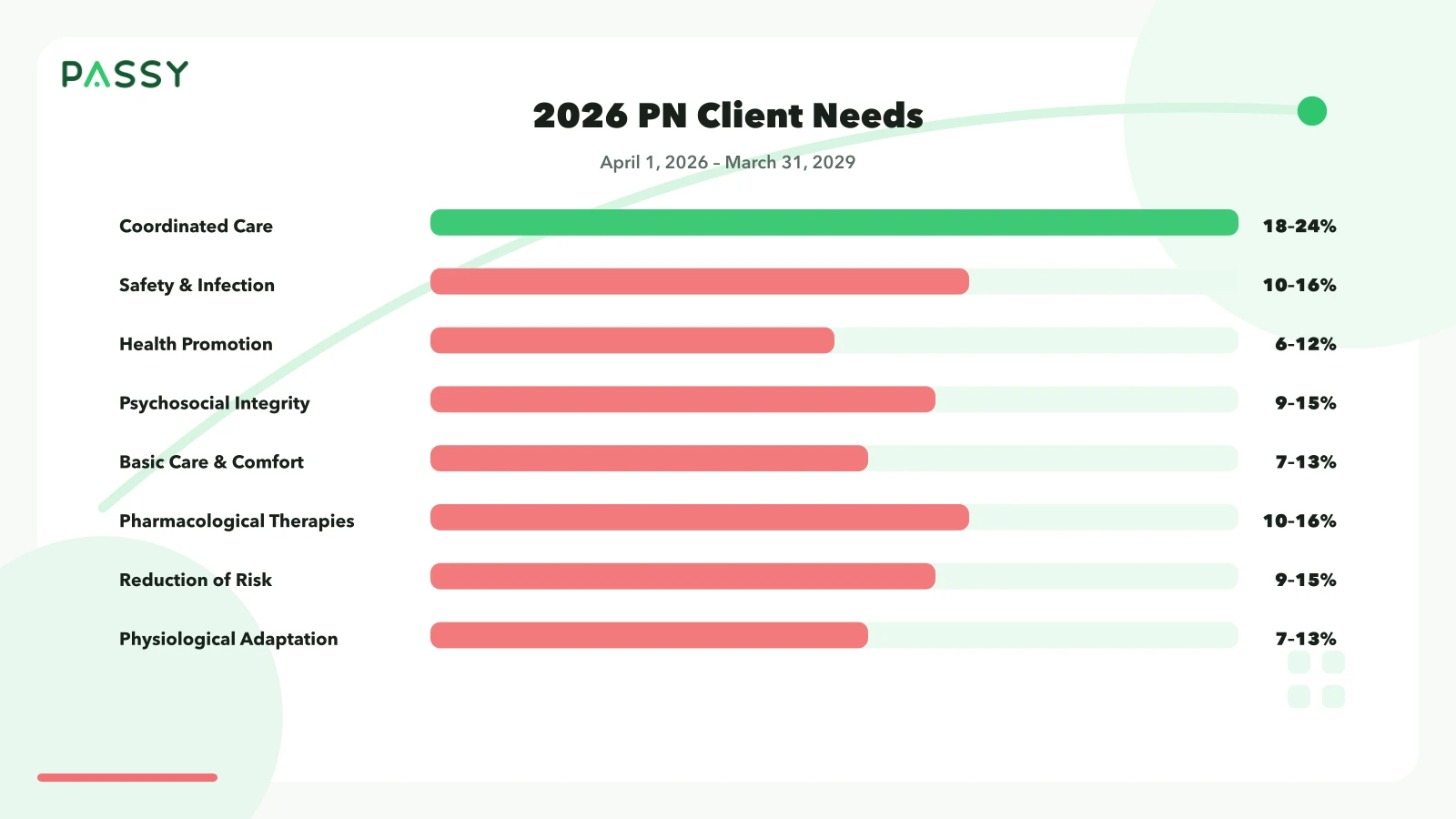
The eight Client Needs the current PN exam uses
The current NCLEX-PN blueprint is NCSBN’s 2026 NCLEX-PN Test Plan, in effect April 1, 2026 through March 31, 2029. It is not the RN plan, and its Client Needs names are the ones to put in your notes. If you test in 2027, it is still your plan: as of October 28, 2026, NCLEX.com lists no newer PN plan.
NCSBN publishes ranges, not a guaranteed count for your seat. CAT can stay inside a range while still feeling “all meds” or “all care coordination” on a given day.
If you studied from the 2023 PN Test Plan, most of that map still applies. The current plan keeps the same Client Needs percentages, the 85–150 item range, and the 52 / 18 / 15 make-up of a minimum-length exam. The visible change is a category name: Safety and Infection Control is now Safety and Infection Prevention and Control. The activity statements now come from NCSBN’s 2024 PN practice analysis.
Safe and Effective Care Environment on PN
Coordinated Care, 18–24%. This is the largest PN category. It covers contributing to the plan, assigning stable tasks within policy, reinforcing teaching, and escalating when a client’s status leaves practical-nurse independence. It is not RN Management of Care. Read NCLEX-PN Coordinated Care before you study “delegation” as if you were the RN.
Safety and Infection Prevention and Control, 10–16%. Isolation, PPE, safe environment, and error prevention. NCLEX-PN safety and infection control is the study page.
Health Promotion and Psychosocial Integrity
Health Promotion and Maintenance, 6–12%. Growth, screening reinforcement, and teaching that the LPN/VN reinforces rather than independently authors as a complete plan.
Psychosocial Integrity, 9–15%. PN weights this higher than the current RN range. Therapeutic communication, abuse reporting cues, and mental-health safety still sit inside scope: stay, ask, report. NCLEX-PN Psychosocial Integrity keeps the category from becoming a DSM dump.
Physiological Integrity, four PN subcategories
| Client Need | Current range | Study as |
|---|---|---|
| Basic Care and Comfort | 7–13% | Comfort, mobility, nutrition, elimination, skin |
| Pharmacological Therapies | 10–16% | Safety, parameters, teaching—not an official drug list |
| Reduction of Risk Potential | 9–15% | Labs, monitoring, complications to report |
| Physiological Adaptation | 7–13% | Response to illness; support and escalate |
Those four pages exist so you can drill one subcategory without pretending it is the whole exam: basic care, pharmacology, reduction of risk, physiological adaptation. Check those Client Needs against mixed questions in Passy’s NCLEX-PN practice so the percentages become decisions, not a poster you never apply.
Clinical judgment is on the PN exam too
The current test plan includes 18 case-study items (three unfolding case studies of six items) and stand-alone clinical-judgment items that are about 10% of the exam depending on length. NCLEX-PN NGN case studies explains the structure. Practice the cue-to-report decisions behind those cases with Passy’s four-option PN questions without treating them as RN independent-management drills.
Item count and pretest items are on how many questions are on the NCLEX-PN. Timing is on how long the NCLEX-PN is.
How to use this map without over-fitting
Do not turn 18–24% into “I will skip psychosocial.” Adaptive exams can still sample every Client Need. A better use of the table is weekly proportion: more Coordinated Care than Health Promotion, without abandoning the smaller categories.
If your notes still say Management of Care or Pharmacological and Parenteral Therapies, you are on an RN outline. Swap the document, then shape the week with a PN study plan from Passy that uses these names.
The NCLEX-PN study guide turns this table into a sequence. The exam hub keeps official sources in one place.
Review the Client Need you keep skipping with Passy’s NCLEX-PN practice.
Trust the source
Official sources
Exam policies can change. Use these primary sources for the most current details.