
PTCB / PTCE guideExam format
What's on the PTCB Exam? 2026 PTCE Content Outline Explained
The current PTCE has four domains: Medications 35%, Federal Requirements 18.75%, Patient Safety and Quality Assurance 23.75%, and Order Entry and Processing 22.50%. This is the January 2026 outline, not a pre-2026 compounding blueprint.
Short answer
The current PTCB exam—the PTCE—covers four knowledge domains on the content outline effective January 6, 2026: Medications (35%), Federal Requirements (18.75%), Patient Safety and Quality Assurance (23.75%), and Order Entry and Processing (22.50%). Items are multiple-choice. Nonsterile compounding and a dedicated NTI knowledge area are not on this outline. DSCSA is. Confirm any study list against the current PTCB PDF, not an older blog table.
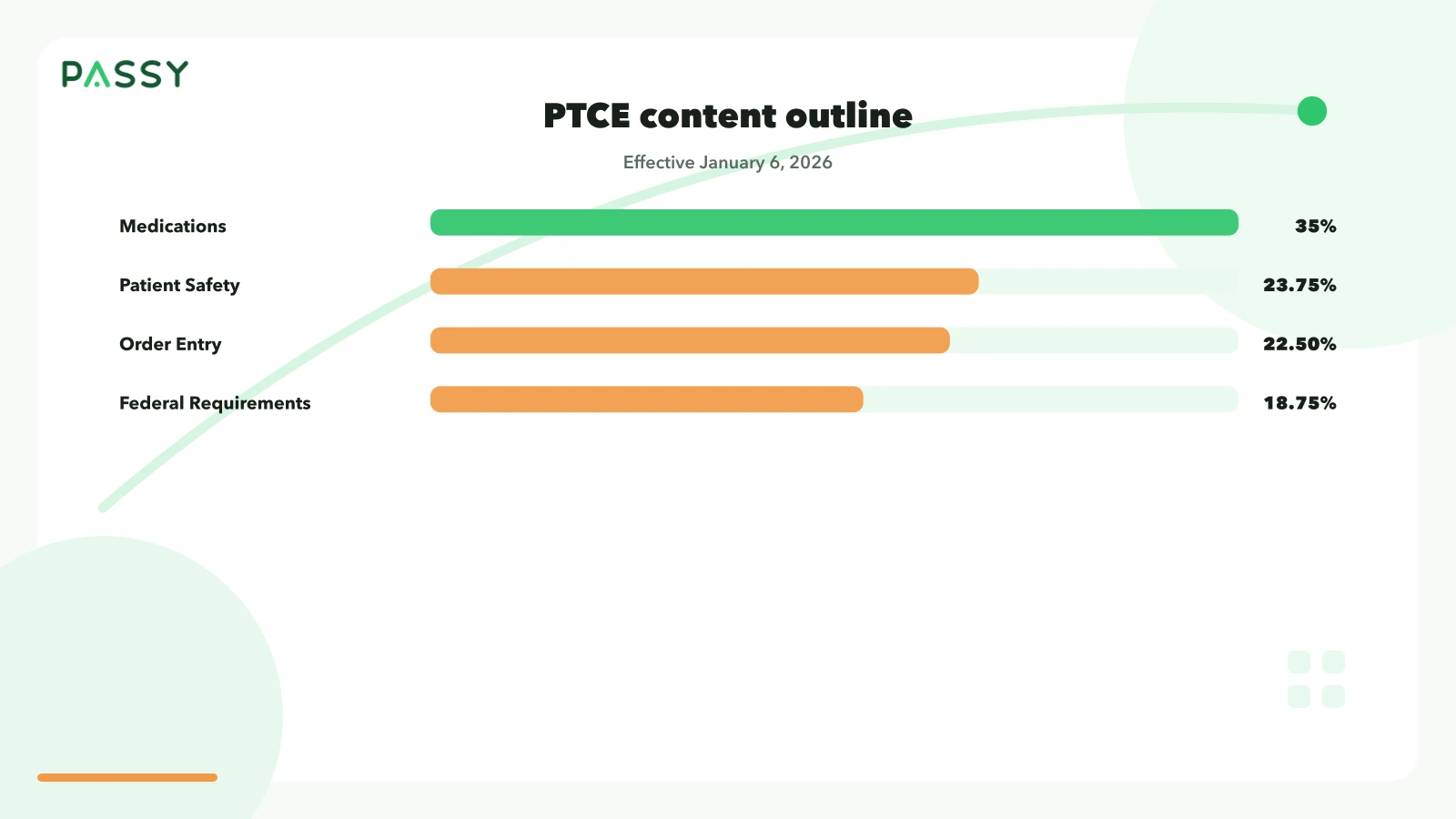
Four domains, current weights, no mystery fifth section
Many study tables still list compounding or older percentages. The PTCE Content Outline that took effect January 6, 2026 is the one to check a resource against, and the sections below walk through each domain in PTCB’s order, with what it covers and where the math sits.
PTCB kept four domains and the same test length after its 2024 job analysis. It changed what sits inside those domains and how much each one counts.
Domain 1 — Medications (35%)
This is the largest domain. The outline asks for generic and brand names, classifications, therapeutic duplications, interactions and contraindications, strengths and doses, dosage forms and routes, handling and duration, side effects and allergies, indications, and stability and storage. Some of those statements are calculation-based.
It does not publish a fixed official “Top 200” roster. PTCB Medications is the study map. Do you need the Top 200? corrects the list myth.
Domain 2 — Federal Requirements (18.75%)
Federal—not state—rules: hazardous and P-list waste, controlled-substance prescriptions and DEA schedules, receiving and storage and take-back and loss, restricted programs such as pseudoephedrine and REMS, FDA recalls, and DSCSA serialization, tracking, tracing, handling, and quarantining. Some statements are calculation-based.
PTCB Federal Requirements walks the knowledge areas. State technician registration is a separate legal question. PTCB’s CPhT page says legal scope is defined by State Boards of Pharmacy.
Domain 3 — Patient Safety and Quality Assurance (23.75%)
High-alert and look-alike/sound-alike medications, error-prevention methods, pharmacist intervention (DUR, ADE, OTC), event reporting (including MedWatch, VAERS, RCA, CQI), prescription errors, and infection prevention and PPE. Several statements include calculation-based knowledge.
Patient Safety & Quality Assurance is the domain page.
Domain 4 — Order Entry and Processing (22.50%)
Formulas, calculations, ratios, proportions, conversions, Sig codes, abbreviations, days supply, quantity, dose, concentration, dilutions, administration supplies, lot numbers, expiration dates, NDC numbers, and procedures for returns and reverse distribution. This is where most of the visible math lives.
Order Entry & Processing covers workflow identifiers. PTCB pharmacy math works original setups. Practice order-entry and calculation questions subject by subject in the Passy PTCB prep app after you can name those knowledge areas without looking.
What is not a current PTCE domain
PTCB’s job-analysis notice removed nonsterile compounding content and alligations, and it removed the dedicated NTI knowledge area. PTCB exam changes in 2026 covers those deletions in detail.
The exam itself is 90 multiple-choice questions, 80 scored. How many questions are on the PTCB exam? explains that count.
Once the outline is clear, let study time follow the four domain weights, then practice all four current PTCE domains in the Passy PTCB prep app so no domain is studied only by itself.
Trust the source
Official sources
Exam policies can change. Use these primary sources for the most current details.