
RBT guideCore RBT Concepts
ABC Data and Functions of Behavior: What RBT Candidates Need to Know
ABC data record what happened before, during, and after a behavior. Functions name what the behavior gets or avoids. RBT items ask you to connect those facts.
Short answer
ABC data record the antecedent, the behavior, and the consequence in observable terms. Functions of behavior name what the behavior typically gets or avoids: attention, tangibles, escape or avoidance, or automatic/sensory reinforcement. On RBT items, match the recorded pattern to the function, then stay inside the technician role. Do not invent a function from a single dramatic session or independently launch a new analysis.
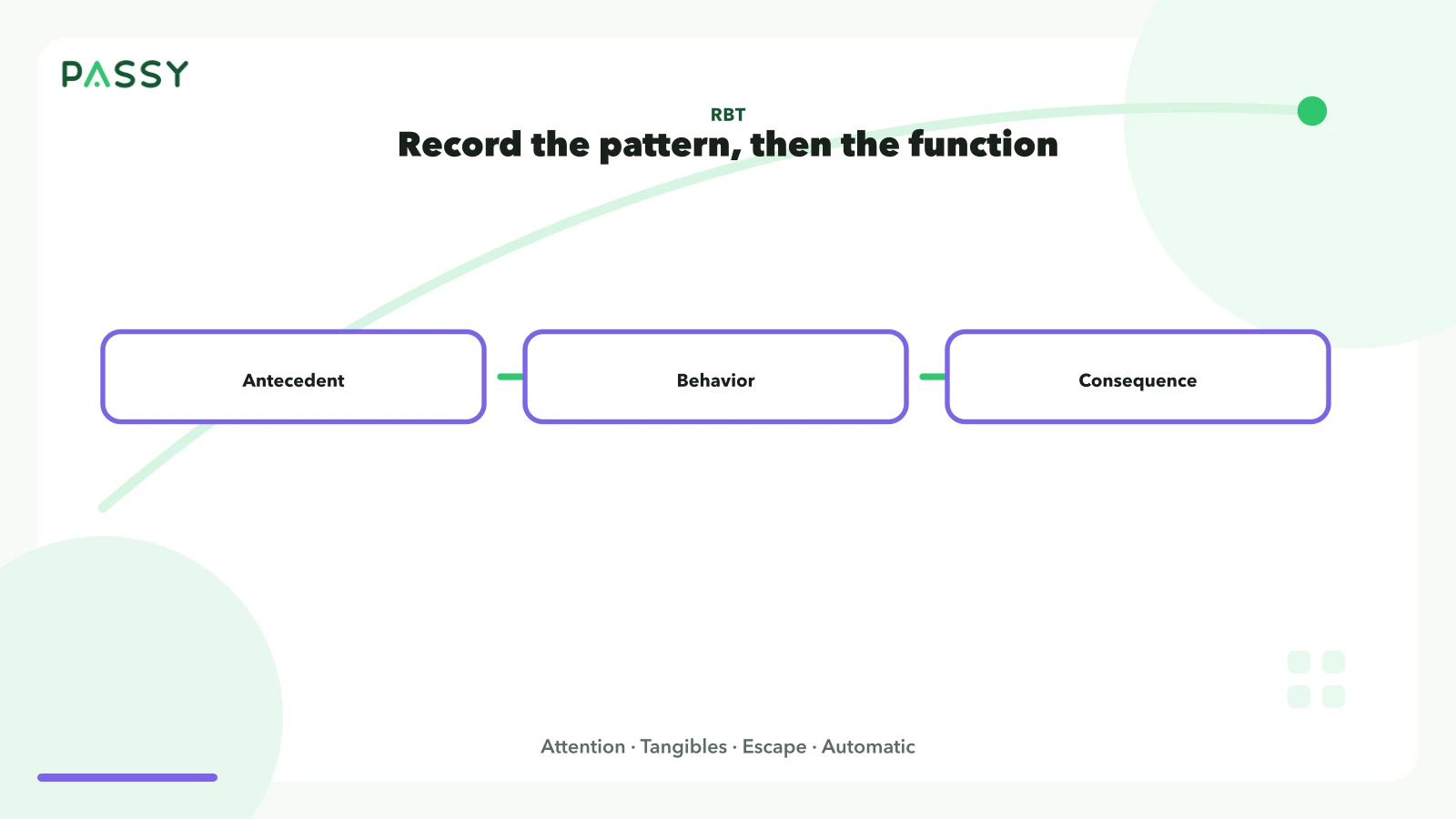
Record the three columns, then look for a pattern
ABC data records what happened before a behavior, the behavior itself, and what followed, so a later function hypothesis has evidence instead of a guess. For example: the technician presents a worksheet (A), the client tears it (B), and the worksheet is taken away (C). Seen again and again, that pattern points toward escape. Practice ABC and function questions in the Passy RBT prep app before you jump to “it’s attention.”
Assessment participation is behavior assessment. Using function to pick a reduction procedure is behavior reduction. Measurement method (count versus interval) is a different question; see continuous versus discontinuous and data collection.
What belongs in each column
A — Antecedent: the situation immediately before: demand presented, attention withdrawn, a preferred item in sight, a transition announced. Not a biography of the client.
B — Behavior: observable movement or vocalization. Not “got upset.”
C — Consequence: what happened next: staff came over, demand removed, item delivered, nothing social occurred. Not what you wish had happened.
A single ABC line is a snapshot. Function is a pattern across lines: the same class of consequence reliably follows, and the behavior is maintained (it keeps occurring or increases).
When a stem gives a clean three-column story, match it to a function, then try fresh scenarios in the Passy RBT prep app.
The functions you must be able to use
Attention: social response maintains the behavior (comments, reprimands, approaching).
Tangible: access to an item or activity maintains it.
Escape / avoidance: removal or delay of a demand or aversive situation maintains it.
Automatic / sensory: the behavior produces its own stimulation without needing a social mediator.
These are working categories for entry-level items, not a claim that every behavior has only one function forever. Mixed or unclear patterns belong to the supervisor’s assessment, not to an RBT declaration in the hallway.
Do not pick automatic just because the behavior looks unusual. Look at whether a social consequence is actually maintaining it.
If you skip the consequence column and guess, read explanations in the Passy RBT prep app that start from what followed the behavior.
Role limits that keep this from becoming an FA course
You may collect ABC data as directed. You do not independently start analog FA conditions because a podcast suggested it. You do not change the behavior plan based on today’s hunch. Report the data. Implement the current plan.
ABC is not a substitute for the measurement the skill program requires. You can take ABC on a problem behavior and still need frequency on a target skill.
When the columns and functions are stable, mix ABC scenarios into exam-style RBT practice in the Passy RBT prep app. The appointment will bury this inside assessment and reduction stems, not under a heading called ABC.
Trust the source
Official sources
Exam policies can change. Use these primary sources for the most current details.