
RBT guideCore RBT Concepts
Continuous vs Discontinuous Measurement for the RBT Exam
Continuous methods capture each occurrence you can record. Discontinuous methods sample intervals and therefore estimate. Here is how RBT items separate them, with a one-table summary.
Short answer
Continuous measurement records each occurrence, duration, latency, or interresponse time you can reasonably capture. Discontinuous measurement samples intervals (whole, partial, or momentary) and therefore estimates how much the behavior occurred. Partial-interval recording tends to overestimate. Whole-interval recording tends to underestimate. Permanent-product recording is neither: it measures a lasting result and is a separate task on the outline. RBT items ask you to match the method—and its distortion risk—to the supervisor’s question.
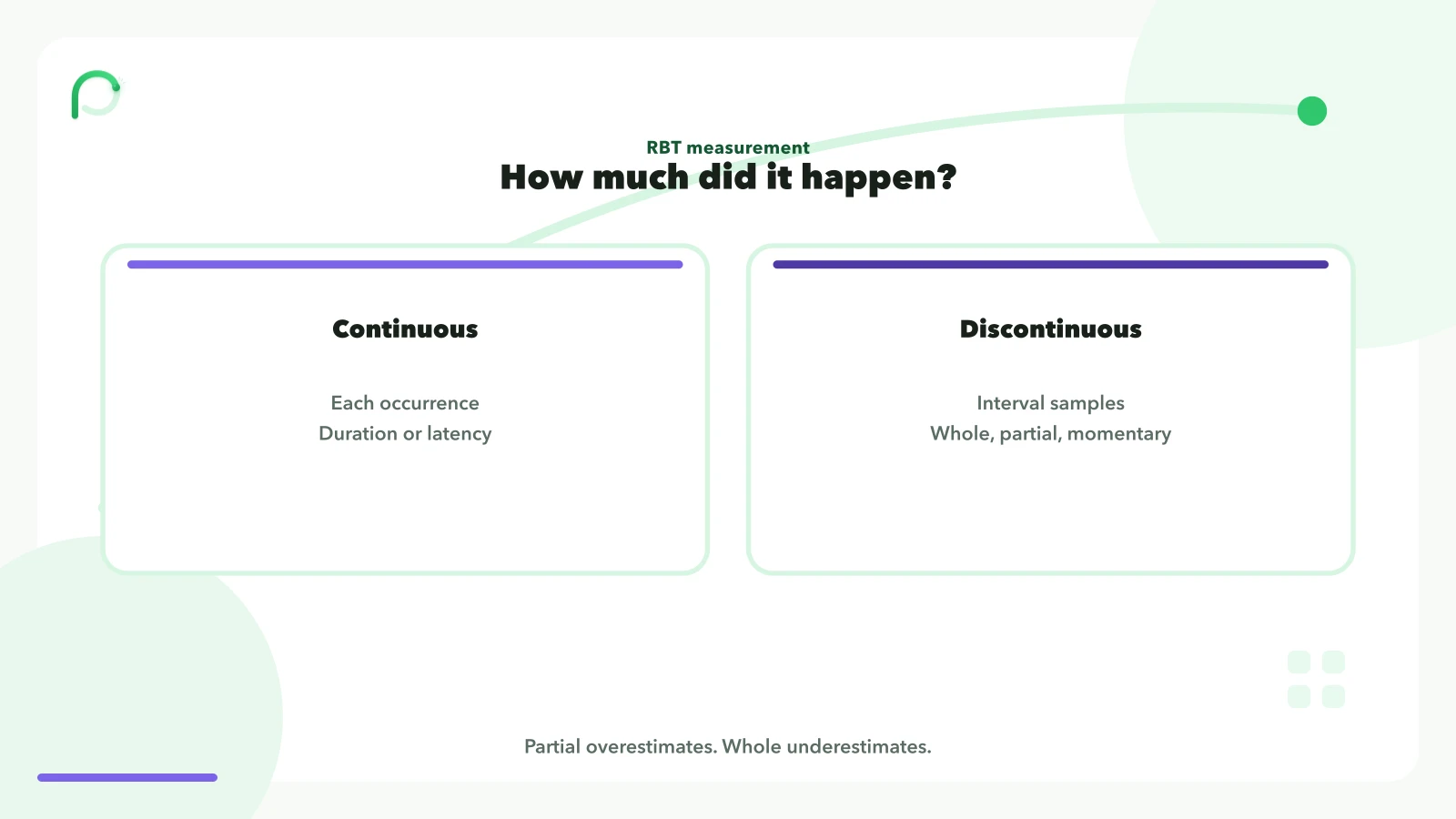
One family counts or times; the other samples
Continuous measurement captures every occurrence you can reasonably record. Discontinuous measurement samples intervals and therefore estimates. For example, tallying each time a client hits is continuous (frequency), while marking a 10-second interval if hitting happened at any point in it is discontinuous (partial interval). Practice naming the measurement method from short descriptions in the Passy RBT prep app before you memorize a chart of every synonym.
Where does permanent product fit? It is neither continuous nor discontinuous. Permanent-product recording measures a lasting result of the behavior after it happens, such as a completed worksheet or a made bed. The RBT Test Content Outline lists it as its own task (A.3), separate from continuous (A.1) and discontinuous (A.2) measurement.
This distinction lives in Domain A and shows up whenever a stem cares about an exact record versus an estimate. The parent domain page is data collection and graphing.
Every RBT measurement method in one table
| Method | Family | What you record | Typical bias or risk | Original example |
|---|---|---|---|---|
| Frequency / rate | Continuous | Each occurrence (rate adds a time base) | Impractical when the behavior is too fast or has no clear start | 6 hits in a 30-minute session, or 12 per hour |
| Duration | Continuous | How long each episode lasts | Needs a clear onset and offset | A tantrum that lasts 4 minutes |
| Latency | Continuous | Time from the cue to the start of the response | Timed from the cue, not from when you noticed | 8 seconds from “line up” to standing |
| Interresponse time (IRT) | Continuous | Time between the end of one response and the start of the next | Not the same as a session rate | 45 seconds between two requests |
| Whole interval | Discontinuous | Interval scored only if the behavior fills all of it | Tends to underestimate | On task for every second of each 15-second interval |
| Partial interval | Discontinuous | Interval scored if the behavior occurs at any point | Tends to overestimate | Any humming during each 10-second interval |
| Momentary time sampling | Discontinuous | Whether the behavior is happening at the moment the interval ends | Misses behavior between checks | In seat when the timer beeps every 2 minutes |
| Permanent product | Neither | A lasting result after the behavior | Valid only if the product could not come from someone or something else | Number of worksheet problems completed |
Continuous: frequency, duration, latency, IRT
Frequency / count / rate records how often a discrete behavior occurs (rate adds a time base). Use it when instances are countable and the question is “how many.”
Duration records how long the behavior lasts. Use it when the question is “how long,” not “how many times it started.”
Latency records the time from a cue to the start of the response. Use it when the question is delay to onset.
Interresponse time (IRT) records the time between the end of one response and the start of the next. Use it when the question is how quickly responses follow one another. The outline lists IRT with the continuous methods.
If you can miss instances because the behavior is too fast or too blended, a continuous method may be impractical. That is often why a supervisor chose sampling instead. The technician still implements the written method.
When a stem gives tallies of each request, choose the continuous count, then try similar measurement questions in the Passy RBT prep app.
Discontinuous: whole, partial, momentary
Whole-interval: the behavior must occupy the entire interval to score. Brief occurrences are missed, so the method tends to underestimate.
Partial-interval: any occurrence in the interval scores the whole interval. Brief occurrences inflate the picture, so the method tends to overestimate.
Momentary time sampling: score whether the behavior is occurring at a specified moment (often the end of the interval). It can miss behavior between snapshots.
None of these is “wrong.” Each answers a different practical question with a known bias. Items fail when you treat a partial-interval percentage as if it were exact duration.
As noted above, permanent product is neither interval sampling nor a count of live occurrences. Do not call a stack of worksheets “partial interval.”
If overestimate versus underestimate still flips, get a clear explanation of each interval rule in the Passy RBT prep app.
What this comparison is not
It is not ABC data. ABC is a structured narrative of antecedent, behavior, and consequence. See ABC and functions.
It is not a license to change the data sheet. If the plan says partial interval, you do not switch to frequency because you prefer it. Ask the supervisor if the sheet cannot be implemented. That reporting step is documentation.
The what-to-study guide places this concept inside Domain A’s 13 items so you do not build an entire calendar on interval definitions alone.
When you can name the method and the bias, put measurement questions into mixed practice in the Passy RBT prep app. The exam will not title the item “continuous versus discontinuous.”
Trust the source
Official sources
Exam policies can change. Use these primary sources for the most current details.