
RBT guideStudy & Preparation
What to Study for the RBT Exam: 2026 Test Content Explained
See how the current RBT Test Content Outline (3rd ed.) divides 75 scored items across six domains, and where study time should go first.
Short answer
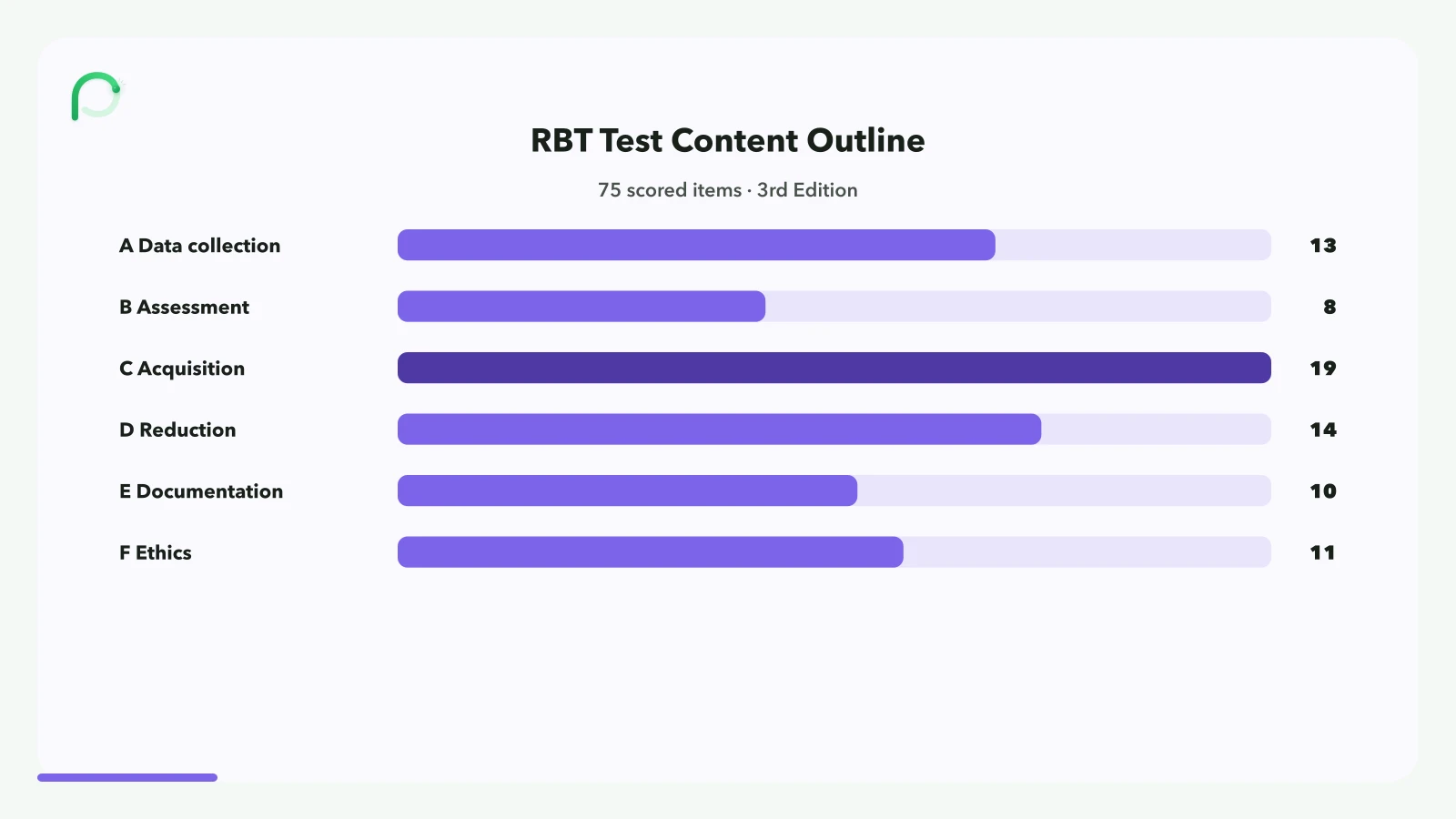
Study the six current RBT Test Content Outline domains, not the retired 2nd Edition Task List. Of 75 scored items, Behavior Acquisition is the largest (19 items), then Behavior Reduction (14), Data Collection and Graphing (13), Ethics (11), Documentation and Reporting (10), and Behavior Assessment (8). Learn technician actions and distinctions in those areas, not a dump of clinic anecdotes.
Study the current outline, not last year’s labels
Study time is wasted when it follows an outline the exam no longer uses. Classify a few current-domain questions in the Passy RBT prep app first so you can see whether your notes still match Data Collection, Assessment, Acquisition, Reduction, Documentation, or Ethics. Those six names are the 3rd Edition map. Older “Task List 2nd Edition” packets are not.
The RBT Test Content Outline (3rd ed.) is the public blueprint for examinations beginning January 1, 2026. Item counts below are of the 75 scored questions. Ten additional unscored items are mixed in; you will not be told which they are, so you treat every item as if it counts.
Where the 75 scored items actually sit
Behavior Acquisition — 19 items (25%). Spend the largest share of study here. Expect reinforcement, discrete-trial teaching, naturalistic teaching, chaining, prompting and fading, discrimination training, generalization, maintenance versus acquisition, shaping, and token economies. The acquisition domain guide and the prompting and reinforcement versus punishment concept pages go deeper.
Behavior Reduction — 14 items (19%). Function first, then the plan element that matches it: antecedent strategies, differential reinforcement, extinction and its secondary effects, punishment, and crisis procedures as assigned. Pair this with ABC data and functions rather than memorizing procedure names in a vacuum.
Data Collection and Graphing — 13 items (17%). Match the recording method to the question the data need to answer. Continuous versus discontinuous measurement, permanent product, graphs, observable terms, and fidelity problems live here. See the data-collection guide and the continuous versus discontinuous comparison.
Ethics — 11 items (15%). These items test the technician role under supervision: competence, confidentiality, public statements, multiple relationships, gifts, and professional interpersonal skills. The ethics guide is the dedicated page.
Documentation and Reporting — 10 items (13%). Objective session notes, notifying the supervisor, and recording variables that affect progress. Story-telling and unsupervised plan changes are the usual traps. The documentation guide covers that skill.
Behavior Assessment — 8 items (11%). Smallest scored domain, still required. Preference assessments, skill assessments, and participating in functional assessment—not independently designing a full functional analysis. The assessment guide stays inside that scope.
When one of those six labels still feels interchangeable, give that domain a focused block in the Passy RBT prep app before you increase volume.
What “studying the outline” should look like in a session
Do not highlight every task letter and call it done. For each task you review, produce three things: the technician action (record, implement, report, or stop and ask), the nearby distractor (the procedure or measurement that looks similar), and the cue that separates them.
That is enough structure for a 25-minute block. It also matches how multiple-choice items are written: four options, one best answer, with distractors that are often real ABA procedures used in the wrong situation.
The study guide overview places this map inside exam-day format. This page focuses on the content split. If you need a calendar rather than a domain list, use the study-plan article or the interactive planner.
What not to over-weight
Clinic war stories, dumps, and reconstructed “this was on my test” threads are not a study source. They are also a professional risk. Original practice aligned to the public outline is the legitimate way to rehearse decisions.
Do not ignore Ethics and Documentation because each is smaller than Acquisition. Combined, they are 21 scored items, more than Behavior Acquisition’s 19. Candidates who only drill DTT and DRA still miss role-boundary and note-quality items.
Do not treat 2025 historical pass rates as a study-time calculator. Those figures describe prior administrations. Your job is coverage of the current six domains plus the ability to apply them under a 90-minute clock.
If two terms keep swapping in your notes, get a clear explanation in the Passy RBT prep app of the distinction your last miss turned on instead of rereading both definitions at the same depth.
A simple allocation if you have limited weeks
If you have about a month, a defensible default is to give Acquisition and Reduction the most minutes, keep Data Collection in every mixed set, and never drop Ethics or Documentation for more than a few days. Assessment can be shorter sessions: name the preference-assessment procedure, then stop. The outline does not ask an RBT to invent the assessment plan.
Training and competency assessment are upstream of authorization to sit. They are not a substitute for exam-domain study. The 40-hour training and competency guides cover those steps.
When the map is clear, practice a mixed set across all six current domains in the Passy RBT prep app. Transfer is the test of whether the outline left the page and entered the decision.
Trust the source
Official sources
Exam policies can change. Use these primary sources for the most current details.