
RBT guideCore RBT Concepts
RBT Prompting and Fading: Prompt Hierarchies and When to Fade
A prompt is extra help that makes a correct response more likely. Fading removes that help. RBT items ask which hierarchy and which next step the plan names.
Short answer
A prompt is extra assistance that makes a correct response more likely. Fading is the planned removal of that assistance so independent responding remains. On RBT items, identify whether the plan uses least-to-most, most-to-least, or time delay, then choose the next prompt step as written. Do not add a more intrusive prompt because it is faster, and do not skip fading because the session looks cleaner with help.
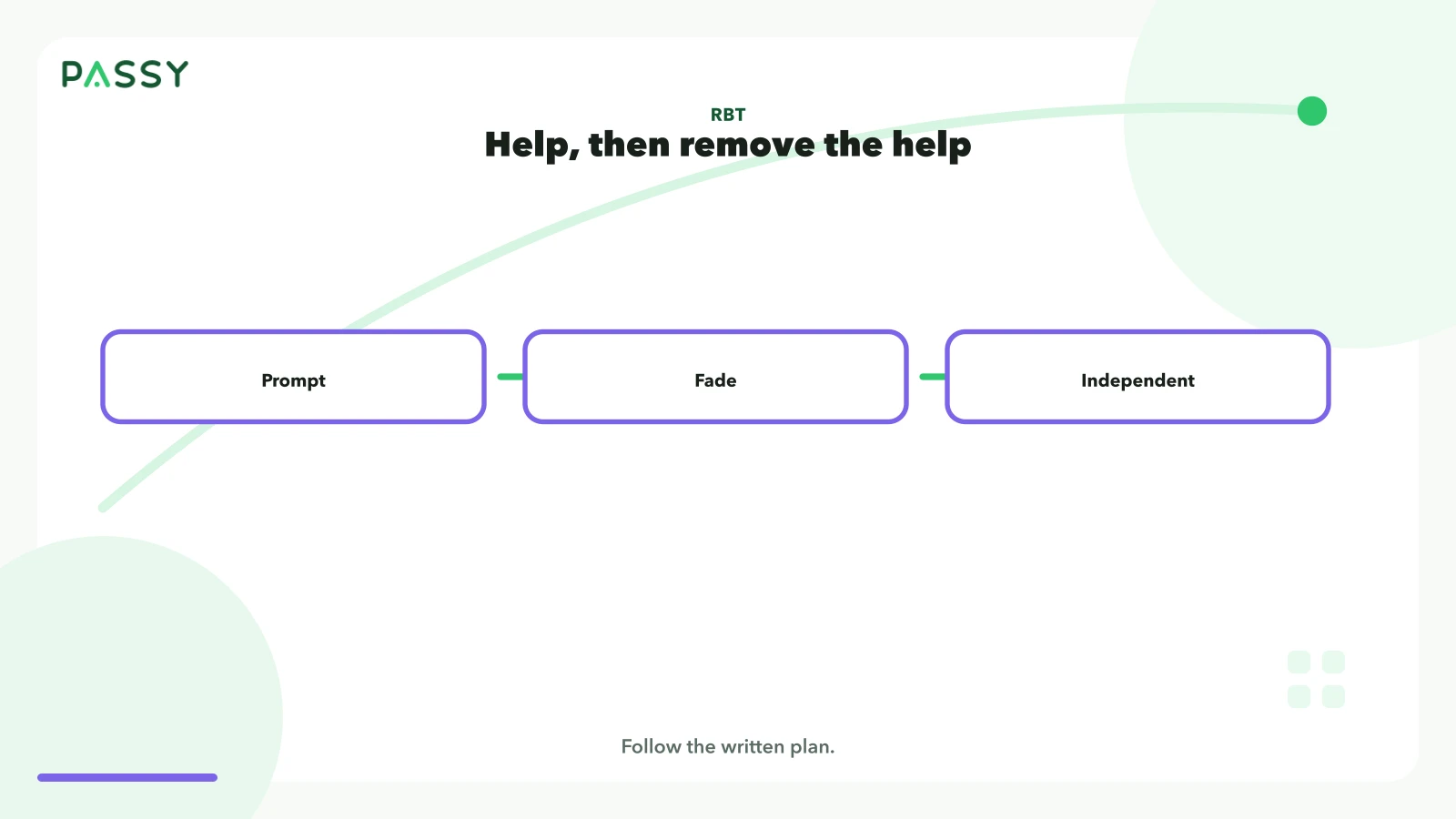
Prompts add help; fading takes it away on purpose
A prompt is extra help that makes a correct response more likely. Fading is the plan for removing that help so independence remains. For example, pointing to the correct card after an instruction is a gesture prompt; pointing less and less across trials until the client responds alone is fading. Practice matching prompt hierarchies to stems in the Passy RBT prep app before you argue about which prompt feels kindest. This is a Domain C skill. The parent page is behavior acquisition.
If help never fades, you may see prompt dependence: correct responding only when the extra cue is there. If you jump to the most intrusive prompt every trial, you may also prevent independence the plan was built to grow.
Hierarchies the items actually name
Least-to-most: wait for independence, then add more assistance only as needed (for example, verbal, then gesture, then model, then physical, if that is the written order).
Most-to-least: start with enough assistance for success, then reduce across trials or sessions.
Time delay: insert a planned wait between the cue and the prompt so independent responding has a chance to occur.
Stimulus fading changes extra features of materials (a highlighted letter that becomes ordinary text). It is not the same as a response prompt from the technician’s body, though both are fading extra help.
The exam will describe the sequence more often than it will need a rare synonym. Learn the sequence in both directions: name from description, description from name.
When two hierarchies still swap, work prompting questions in the Passy RBT prep app that change only where assistance starts.
What prompting is not
It is not the consequence. Reinforcement or punishment happens after the response. See reinforcement versus punishment. Prompt, response, then consequence is a useful DTT order; do not label the token as a prompt.
It is not errorless teaching as a slogan you can apply without the plan. Some plans use extra early prompts to reduce errors. Implement that plan if written. Do not invent it.
It is not a reduction procedure. A prompt can be part of teaching a replacement skill inside a Domain D package, but the prompt rules still come from the acquisition plan. See behavior reduction.
If you miss items by “just helping more,” read explanations in the Passy RBT prep app that name the next planned step, not the fastest success.
Fidelity and role
Do not change the hierarchy because a coworker prefers a different order. Ask the supervisor. Record the prompt level the data sheet requires so graphs mean something. The what-to-study guide places this inside Acquisition’s 19 items.
When you can name the hierarchy and the fade step, put prompting questions into mixed practice in the Passy RBT prep app. Isolated prompt drills miss the consequence that follows the response.
Trust the source
Official sources
Exam policies can change. Use these primary sources for the most current details.