
RBT guideCore RBT Concepts
Reinforcement vs Punishment: How to Tell Them Apart on RBT Questions
Classify by what happens after the response and whether that response becomes more or less likely later. Positive/negative is about added versus removed stimuli.
Short answer
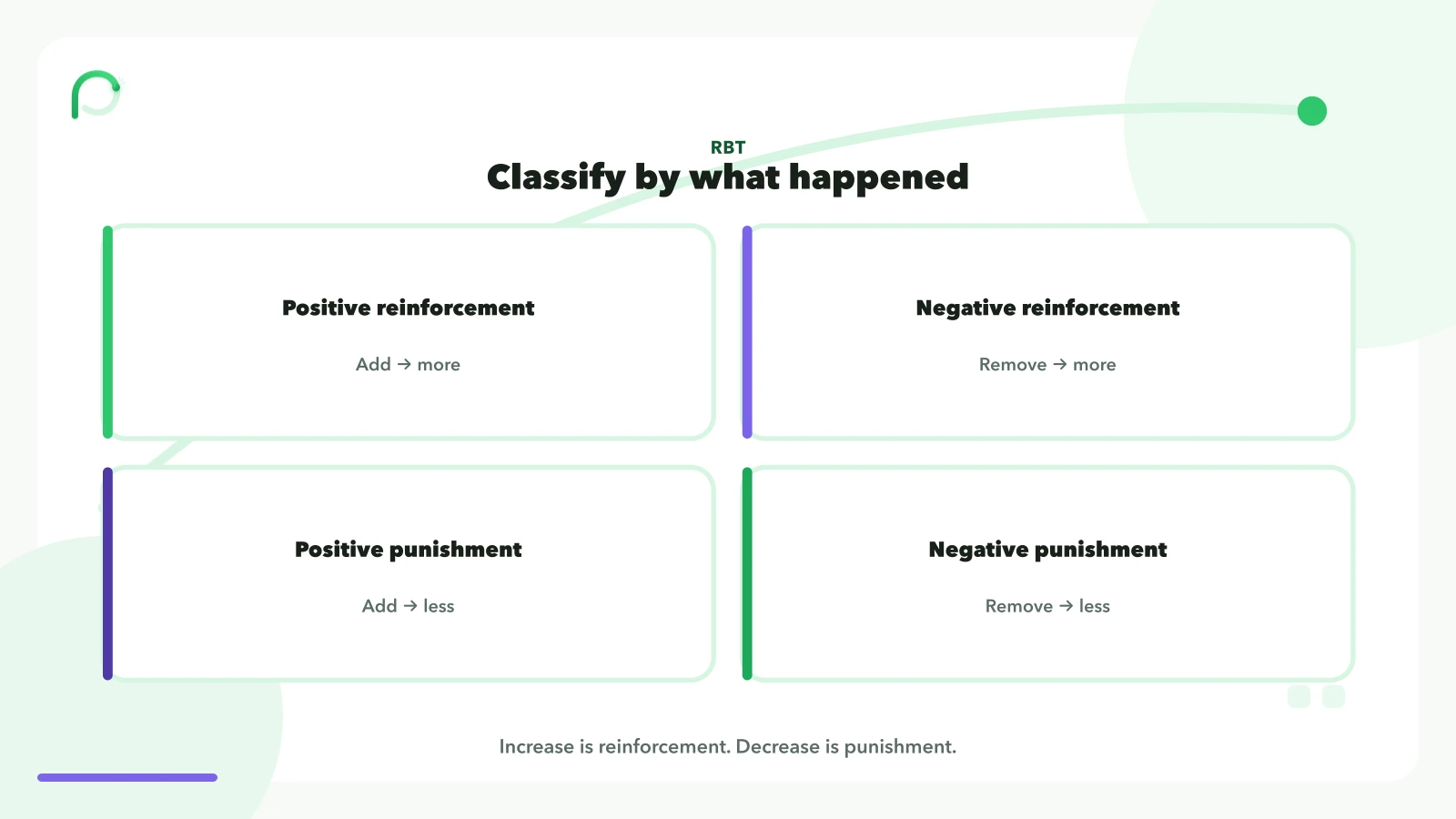
Classify the procedure by two facts: what changed after the response (stimulus added or removed) and what happened to that response later (increased or decreased). Increase means reinforcement. Decrease means punishment. “Positive” means a stimulus was added. “Negative” means a stimulus was removed. Everyday moral meanings of those words will mislead you on RBT items.
Classify the change after the response, then the later effect
Reinforcement and punishment are classified by what happens after the response and by whether that response becomes more or less likely later. Practice naming both parts of that classification in the Passy RBT prep app on short scenarios before you debate whether the consequence “felt mean.” The exam does not grade your moral vocabulary. It grades whether independent clean-up increased after a noisy demand was removed (negative reinforcement) or whether a response decreased after a preferred item was taken (negative punishment).
This distinction sits in Domain C and Domain D. Parent pages: acquisition and reduction.
The four quadrants without the slogans
Positive reinforcement: something is added after the response, and the response becomes more likely (praise, a token, a preferred snack as written).
Negative reinforcement: something is removed after the response, and the response becomes more likely (a demand ends after a correct break request).
Positive punishment: something is added after the response, and the response becomes less likely (a reprimand, if the data later show a decrease—and only if the plan allows it).
Negative punishment: something is removed after the response, and the response becomes less likely (loss of a token or privilege as written).
If the stem does not tell you the future effect, you cannot finish the classification. “The technician said no” is not yet punishment. Watch the later data.
When only the added/removed piece is clear, work questions in the Passy RBT prep app that also state whether the behavior went up or down.
Nearby mix-ups the exam likes
Extinction is withholding the maintaining reinforcer, not adding an aversive. It can look “negative” in everyday speech and still not be negative punishment.
Response cost is typically negative punishment (token loss) if the response decreases. Time-out is removal from reinforcement, also usually classified on the punishment side when it decreases behavior—implement only as trained and written.
Reinforcing an alternative while problem behavior is not reinforced is DRA, not “punishing by ignoring” as a complete analysis. Function still matters.
Prompting is extra help before or during the response. It is not a consequence quadrant. See prompting and fading.
If everyday English keeps winning, check each explanation in the Passy RBT prep app against added/removed and up/down.
Ethics still limit which quadrant you may use
You do not add aversive consequences because a four-quadrant table exists. You implement the written, trained plan and ask the supervisor when the stem offers a new punisher. The ethics guide is the role page.
Do not study this comparison as a guarantee you will pass. It is a classification skill the outline actually uses.
When the quadrants are stable, put the four quadrants into mixed practice in the Passy RBT prep app beside measurement and ethics items. Isolated quadrant drills collapse on a mixed form.
Trust the source
Official sources
Exam policies can change. Use these primary sources for the most current details.