
ASVAB guideSkills
ASVAB Mechanical Comprehension: Levers, Gears, and Pulleys
Read the diagram before you calculate. These ideal levers, gears, and pulleys state the friction they ignore, and they are not a service composite.
Short answer
Mechanical Comprehension asks about mechanical and physical principles. Inspect the diagram, name the forces and distances, and state whether friction is ignored. A class 1 lever balances when effort times effort arm equals load times load arm. Meshing gears reverse direction. An ideal movable pulley with two supporting strands halves the effort. This subtest is not itself a service line score.
Read the picture first
The official description is knowledge of mechanical and physical principles. Before you multiply, name the object, the pivot or the mesh, the direction of the arrow, and the assumption. The figures on this page ignore friction unless a sentence says otherwise. A real rope or gear will need more effort than the ideal number.
Mechanical Comprehension is one subtest. A service’s mechanical composite may include it plus other subtests. The Air Force Mechanical group, for example, also lists Arithmetic Reasoning, Auto and Shop, and Verbal Expression. Line scores are where that composite belongs. Doing well on a lever does not assign a job.
Lever
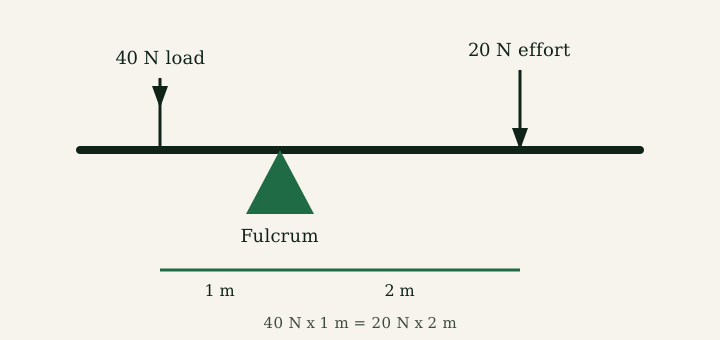
The fulcrum is between the load and the effort, so this is a class 1 lever. The load arm is the distance from the load to the fulcrum, 1 meter. The effort arm is 2 meters. Friction is ignored, and the beam’s own weight is ignored.
Balance: effort × effort arm = load × load arm.
20 N × 2 m = 40 N × 1 m = 40 newton-meters.
If the arms were swapped, the same 40 newton load would need 80 newtons of effort, because the effort arm would be the short one. Equal arms need equal forces. The longer arm is the one that lets you use less force, not the one that “has more force stored in it.”
Gears
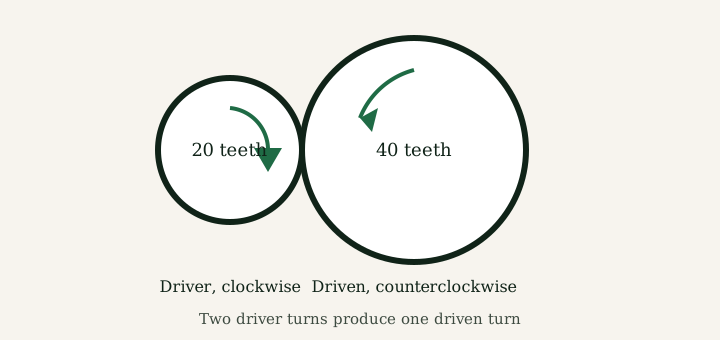
The circles touch at one point. Teeth push, so the second gear turns the other way. Clockwise in, counterclockwise out. A third gear meshed with the second would turn clockwise again. This page has only two.
The driven gear has twice the teeth, 40 versus 20. It turns half as often. Two full turns of the driver produce one full turn of the driven gear. Slip and friction are ignored. If you answer “two turns clockwise,” you kept the driver’s count and the driver’s direction. Both are wrong for the driven gear.
Pulley
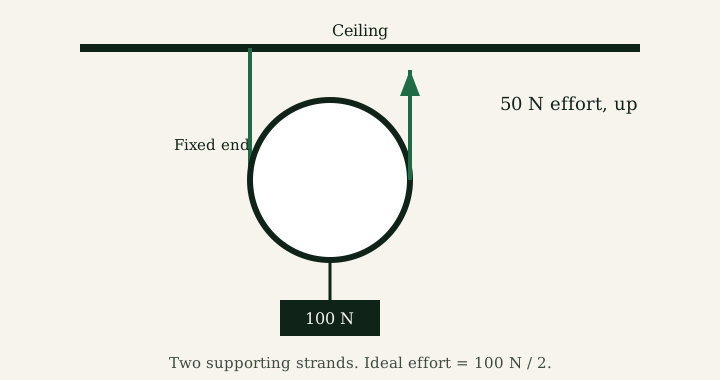
Count the rope segments that support the load. Here there are two: one rising to the fixed end on the ceiling, and one rising to the hand. With friction ignored, the effort is the load divided by the number of supporting strands: 100 N / 2 = 50 N, pulled up.
A single fixed pulley on the ceiling only changes direction. It still has one supporting strand, so the ideal effort stays equal to the load. Do not halve the effort just because you see a wheel.
The hand in the figure moves farther than the load. Ideal work is force times distance. Half the force means about twice the rope travel for the same lift. That trade is the point of the movable pulley. It is not a way to spend less energy once friction returns.
A short self-check
A class 1 lever has a 30 newton load 2 meters from the fulcrum. The effort is 4 meters from the fulcrum on the other side. Friction is ignored. What effort balances the load?
E × 4 = 30 × 2, so E × 4 = 60, and E = 15 newtons. If you answered 60, you multiplied and stopped. If you answered 7.5, you divided the load by the load arm.
Practice another mechanical item only after you can say the assumption out loud. Rates and unit changes, if the stem becomes a word problem, belong with the formula reference and the study guide.
Trust the source
Official sources
Exam policies can change. Use these primary sources for the most current details.